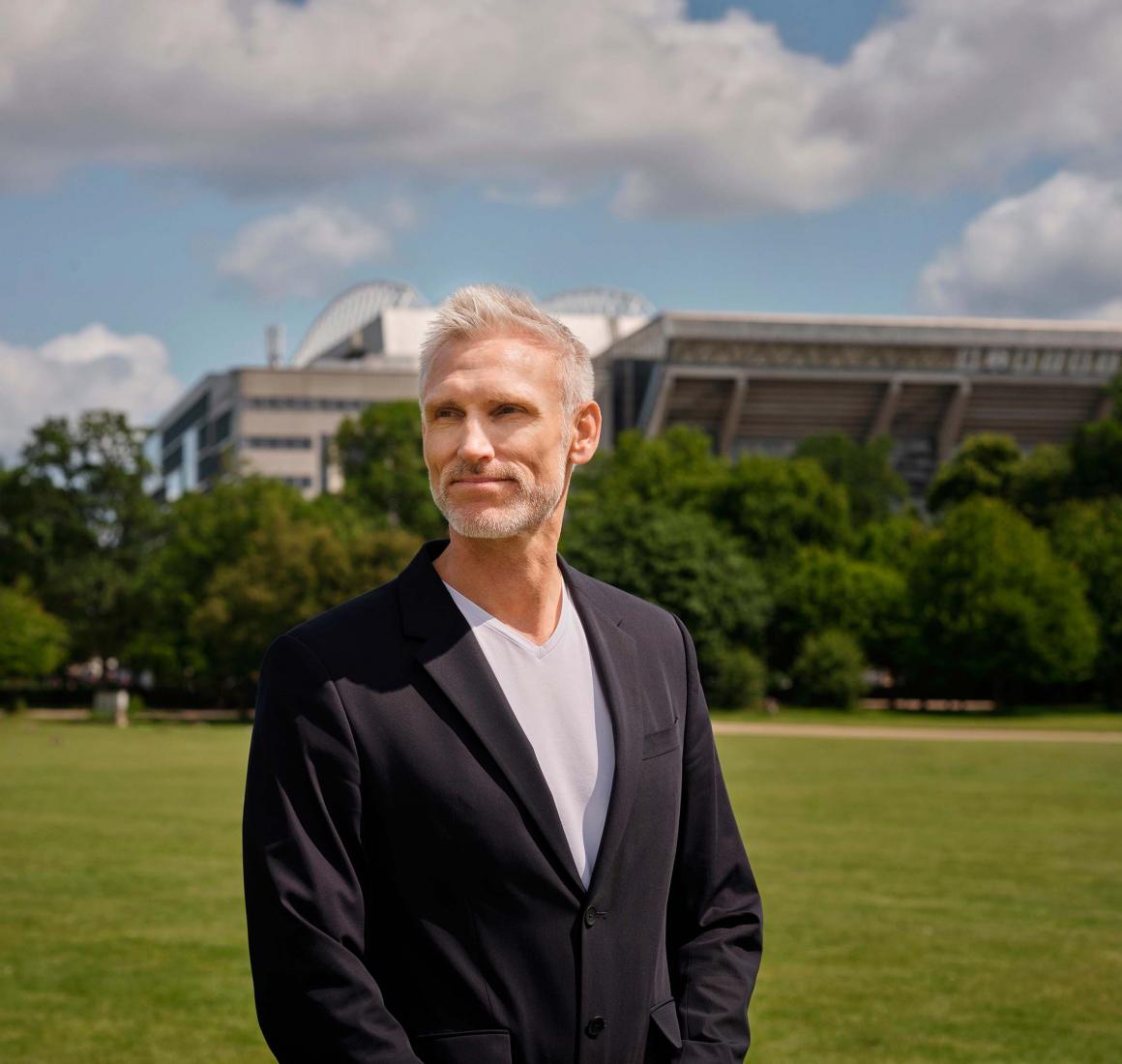
Diversity is nothing without inclusion
Deputy Police Inspector Daniel Benner believes that diversity is a management treasure, and inclusion is the key to the treasure chest. "We can strive for gender balance in hiring, for example, but if we don't bring diversity into play when making decisions, we miss out on the opportunities that diversity offers," he says.
According to Deputy Police Inspector Daniel Benner, the 'Where's Wally' books can illustrate one of the challenges of leading an organisation towards more diversity: the books immediately represent a very broad diversity with many people and a great wealth of detail. But the concept of the books is also to look for something specific. Namely the white man Wally. That tunnel vision can show public leaders how opportunities can be missed. Because despite quite extensive diversity, it is not taken into account.
"Research indicates that diversity increases the quality of decision-making processes, and Where's Wally can teach us that diversity cannot stand alone. We can strive for gender diversity in employment, but if it is not included in the decisions, then we pass over the opportunities that lie in diversity. Diversity is nothing without inclusion. If we simply look for what we usually do and do what we usually do, then diversity changes nothing," says Daniel Benner. And he emphasises that his purpose is not to criticise Where's Wally books, but simply to draw a thoughtful and recognisable parallel.
This is what research on diversity says
1) Policy – Diversity promotes the organisation's social responsibility and sustainability.
2) Economy – Diversity promotes profit creation or profit realisation.
3) Strategy – Diversity promotes utilisation of the organisation's talent pool.
Professor & MPG lecturer Sara Louise Muhr and Ph.D. & psychologist Christina Lundsgaard Ottsen point to the core arguments for including diversity.
The key to the treasure chest
According to Daniel Benner, diversity can be considered a managerial treasure and inclusion is the key to the treasure chest. That's why he chose to investigate gender diversity in the police in his final master's project in the Master of Public Governance (MPG) programme. And he was awarded the prize for the best project of the semester.
Daniel Benner is head of the National Forensic Center under the National Unit for Special Crime, which supports Denmark's police districts with crime scene investigations in the most serious crimes. Both in his job and on the MPG, where he has met leaders from the entire public sector, he has become aware of one particular thing:
"I don't know best myself, and I therefore value different perspectives on problems. At the same time, I find that the different perspectives are often linked to diversity.”
Daniel Benner has focused on gender in his assignment as an example of diversity, also because gender diversity can be a lever for other forms of diversity. The starting point is figures from the Danish National Police from 2022, which, according to Daniel Benner, show an imbalance in terms of gender diversity in management, even though the police as an organisation positively articulates promoting diversity.
7% women and 93% men among the managers in the police have an education within the police. If you look at leaders in the police, who have, for example, an academic educational background, then in comparison, leadership positions are occupied by 58% women.
"When women are both able and willing, just like men, it must be assumed that there should be a roughly equal distribution in how many per gender are promoted as managers. But the figures also show that of the 19% of female police officers, only 4% become managers. In comparison, men make up 81% of the police force, and 11% of them become leaders."
According to Daniel Benner, this can be a challenge for the police and other organisations where gender distribution is similar.
"Complex tasks call for competent leadership and quality decision-making because the tasks are difficult to embrace. Diversity increases the quality of decision-making processes," he says, referring to research from Professor Sara Louise Muhr, who teaches on the MPG program and who has also supervised Daniel Benner in his master's project.
“As a leader, you must practice accepting your own imperfection. A leader must not necessarily know the best or the most, but embrace diversity and use it to make better decisions.” Daniel Benner
Deputy Police Inspector
Take the course Managing Diversity and Inclusion
The course is taught in Danish 🇩🇰
Improve your ability to ensure diverse representation in leadership and professional groups, and gain practical tools for leading diversity in ways that foster an inclusive workplace culture where individuals can develop and apply their unique strengths.

Meritocracy can paradoxically slow down diversity
Daniel has conducted a number of interviews with police employees who explain that they believe in meritocracy - that the most suitable person gets the job. The research also suggests that in Western societies, there is generally a high belief in meritocracy.
Typically, a potential leader works in a management position for a year and a half. Then the position is advertised and, in principle, anyone can apply for it. This is also the case elsewhere in the public sector, and the argument can be that leadership must be learned in practice and not just in theory.
"I don't dispute that fact. However, the implications of the master's project suggest that we can structurally remove some diversity barriers by advertising the position and making it open to everyone prior to the term of office. My respondents believe that meritocracy works in the police. But at the same time, they also mention that they may have a perception that positions may in some cases be filled in advance. This leads me to say that meritocracy is more at stake than in play, because it doesn't work the way we think it does, and this is due to our own bias. If we don't more actively seek to block some of the barriers to diversity, we risk missing out on a talent pool, which means there's a risk that it's not always the most suitable person who gets promoted," he says and continues: "The people I've interviewed want gender diversity and diversity in general, but at the same time they find it difficult to explain why there isn't any. My guess is that bias can explain the lack of gender diversity."
According to Daniel, there may be an equality bias at play, where we recruit those who are similar to ourselves. This means that management reproduces itself, and if a person has worked in a position that is advertised, we will compare all other candidates to that person. And this is typically in favor of the person who has served in the position. Therefore, it makes sense to structure the process so that the selection for the managerial position is based on applications at the beginning of the process rather than at the end, he says.
Another solution would be to anonymise applicants as far as possible in the process. Both in terms of name and photo.
Daniel emphasises that it is of course also relevant to look at the fact that there is a special dynamic at play in the police, because there is a deep dependence on the admission to the police academy. If more women are not admitted there, it will be difficult to increase the proportion of female leaders with a police education.
Don't solve the challenge before you know the problem
Daniel's MPG education has helped him delve deeper into problems. Both in relation to the gender diversity assignment to identify the underlying bias that may be contributing to the gender imbalance, and other problems he encounters in his work.
"I investigate the problem instead of immediately pursuing a solution. And we can call it a problem, because problems are there to be understood and looked at from different angles and then the solution can be qualified. Over the last decade, we've been clucking our tongues and renaming problems "challenges", which is a very action-oriented term that doesn't require much thought and understanding. Because if we solve the challenges before we know the problems, we don't understand what's really wrong, and there's a danger that it becomes a solution to a symptom rather than to a problem," he says.
When asked if he has any advice for other public sector leaders to promote diversity in their organisation, he replies: "As a leader, you have to practice being comfortable with your own imperfection. A leader should not necessarily know best or most, but embrace diversity and use it to make better decisions. The worst decisions I make are the ones where I don't involve others and stay in my own echo chamber. Start by asking someone for advice, even sometimes those you wouldn't normally ask. Because it's important to remember that it's not just about diversity, but also about how we include it."
Here you can read Daniel Benner's master's project on how the paradox of meritocracy and bias affects gender diversity in the police. The document is in Danish 🇩🇰.
Keep reading
Diversity wins: turn differences into an advantage

Medledelse: Det er ikke nødvendigvis dig som leder, der skal lede
We are not as inclusive as we think we are.. but we can be
Your gateway to more knowledge
Did you find this content interesting? Sign up for our newsletter and gain access to more of our research findings and events.
With the world’s grand challenges awaiting us, we need to continuously evolve, gain new knowledge and insights, and upskill.
Dive into a world of knowledge by signing up below. You will get:
- Personal event invitations
- Pertinent research-based insights on business and society
- Information about the next intakes of our Executive Education programmes and courses
Keep learning

Master of Public Governance
Executive MBA

Ledelse af diversitet og inklusion