Why Collective Leadership Should Be on Your Radar
Leadership is not exercised solely by those in formal leadership positions. It emerges continuously through interactions between people. This is the core idea behind collective leadership. In this article, Mary Uhl-Bien and Anders Trillingsgaard explain why it is important to view leadership in this way, and what it means for leaders.
Who leads in your organisation? Most people would probably answer: the leaders. But take a closer look at how work actually gets done, and it quickly becomes clear that leadership is exercised in many places across the organisation. Whenever employees take initiative, solve problems, make decisions, and bring others with them, they help create direction and momentum. In other words, they are helping to generate leadership.
This is the central idea behind collective leadership: leadership is not something exercised solely by those in formal leadership roles. Rather, it emerges through interactions between people as some take the lead, others follow, and roles shift along the way. This is neither a new phenomenon nor the latest management buzzword. Leadership has always worked this way. What is new is that we have become more aware of it. And as organisations face increasing complexity and pressure, understanding and supporting these dynamics has become more important than ever.
In this article, leadership scholar Mary Uhl-Bien and leadership expert Anders Trillingsgaard explain why leaders should pay attention to collective leadership, what it means in practice, and how it can help organisations achieve better results.
Leadership Is Something We Create Together
"Collective leadership is, first and foremost, a different way of understanding leadership. While the concept encompasses a range of perspectives, at its core is the idea that leadership is not something exercised solely by an individual formal leader. That is simply not how organisations work in reality," says Mary Uhl-Bien, Endowed Professor of Leadership at the Neeley School of Business, Texas Christian University (TCU).
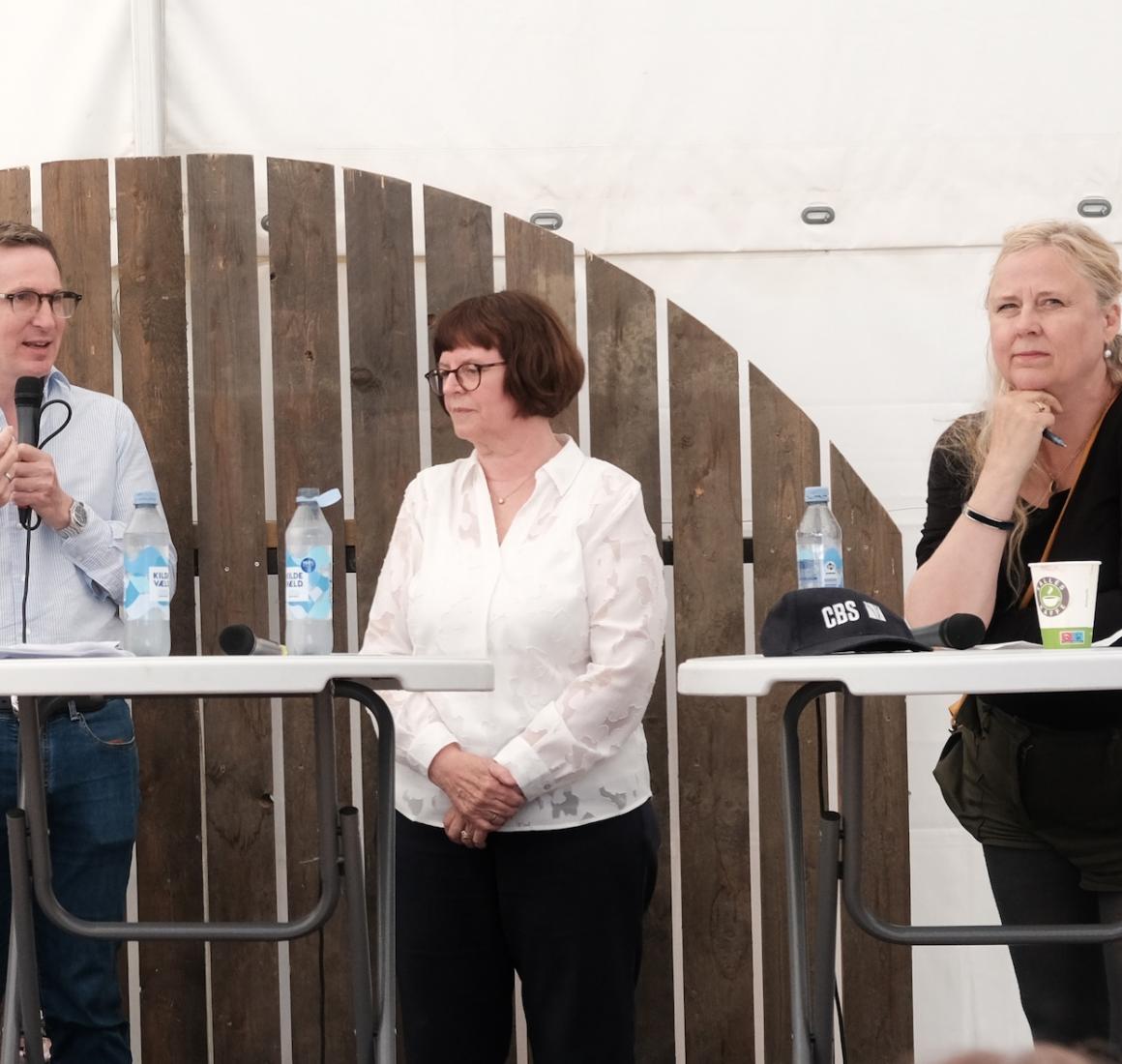
Uhl-Bien is an internationally recognised pioneer in contemporary leadership research and visited Copenhagen on 17 September to introduce the concept of collective leadership at a major event hosted jointly by Djøf and CBS Executive Education.
In practice, leadership emerges through interactions between people. Some take the lead, others follow, and roles shift across titles and hierarchies as circumstances change. According to Uhl-Bien, leadership is co-created through this dynamic interplay between leading and following.
"This is what happens when people work together to solve problems, develop ideas, make decisions, and achieve meaningful outcomes," she says.
If we want to understand where leadership truly takes place, we therefore need to move beyond focusing solely on individual leaders and pay greater attention to the processes through which leadership emerges: the interactions where people influence one another and collectively enable organisations to function and succeed.
“Today, it is more important than ever to understand that leadership is something we create together, because organisations must address increasingly complex challenges in increasingly complex environments” Mary Uhl-Bien
Endowed Professor of Leadership at Neeley School of Business, Texas Christian University (TCU)

Leadership Shifts Between People
Anders Trillingsgaard is a leadership expert, partner at UKON, and adviser to Danish organisations. According to him, an important point is that collective leadership is not something leaders need to introduce or implement. Leadership is already being co-created throughout the organisation, whether leaders recognise it or not.
"The key is to notice the leadership that is already taking place in everyday work and in the organisation's ongoing processes," he says.
In practice, this might happen when a leader sets the direction and framework for a task and then hands responsibility over to an employee, who makes the day-to-day decisions and drives the work forward. If the employee later encounters a barrier they do not have the authority to remove, the task returns to the leader. The leader uses their formal position to remove the obstacle and then hands responsibility back.
Leadership may also reside with the employee whose expertise makes them a natural point of reference for colleagues, or with the critical colleague who challenges a strategy and, in doing so, helps improve it.
"In other words, leadership shifts between people depending on what the task requires at a given moment," says Anders Trillingsgaard.
Why Everyone Is Suddenly Talking About Collective Leadership
According to Mary Uhl-Bien, the reason collective leadership has often gone unnoticed is that traditional views of leadership have largely focused on the formal leader.
That perspective is now beginning to change. The conditions under which organisations operate have evolved, making it increasingly important to understand the leadership that takes place throughout the organisation rather than only at the top.
"Today, it is more important than ever to understand that leadership is something we create together, because organisations must address increasingly complex challenges in increasingly complex environments," she says.
Tasks are more interconnected, change happens faster, and the knowledge required to solve problems and make decisions is dispersed across the organisation.
"That is why it no longer makes sense to focus solely on the decisions and actions of formal leaders.
We also need to pay attention to the relational processes through which leadership emerges: the spaces where solutions are developed, where people influence one another, coordinate their efforts, and make decisions. When you begin to see where an organisation's leadership capacity emerges, it becomes much clearer where and how formal leaders can support it."
When Competing Priorities Pull in Different Directions
Anders Trillingsgaard sees this complexity firsthand in the organisations he advises. Increasingly, organisations must navigate multiple priorities, dilemmas, and interdependencies simultaneously. Part of the explanation is that organisations have become larger, more interconnected, and more dependent on collaboration across functions.
Consider a manufacturing company where the sales function needs one price point to remain competitive, while production must meet specific quality standards. On top of that come new regulations, technological developments, and changing market demands. These considerations often point in different directions, yet they must ultimately be reconciled.
"The consequence is that organisations need the ability to deal with more of this complexity where it arises and when it arises," says Anders Trillingsgaard.
“The goal is to enable your employees to make sound decisions, coordinate effectively with one another, and know when an issue should be escalated back to you.” Anders Trillingsgaard
Ledelsesekspert og partner i UKON

You Need to Know How to Follow, Too
According to both experts, this also has important implications for how you fulfil your role as a formal leader. When knowledge and expertise are distributed across the organisation, it cannot be assumed that you should always be the one taking the lead.
At times, leadership may rest with the person who has the strongest expertise, the most promising idea, or the closest understanding of the problem at hand.
"An important leadership capability is knowing when to lead and when to follow. Followership is not something reserved for employees. It is also part of the role of a formal leader," says Mary Uhl-Bien.
"When others are better positioned than you to address a challenge, your role becomes one of supporting, developing, and helping advance their ideas. Collective leadership does not change your responsibility as a formal leader. It changes how that responsibility is exercised."
Activating the Organisation's Many Decision Engines
To illustrate what it means to support and strengthen leadership among employees, Anders Trillingsgaard describes organisations as already containing multiple "decision engines". The task is to ensure they are used to their full potential.
"The goal is to enable your employees to make sound decisions, coordinate effectively with one another, and know when an issue should be escalated back to you," he says.
This requires leading at the right level. When employees possess greater expertise in a particular area, leadership should be able to shift to where that expertise resides. At the same time, leaders should examine their own responsibilities and consider whether tasks they experience as routine obligations could represent valuable development opportunities for someone else.
"If the executive team spends its time deciding what partitions should be installed in the staff canteen, the organisation's most expensive leadership resource is being used on something others may be better equipped to decide. For the executive team, it is a decision below their level. For an employee, it may be an opportunity to learn and develop."
Creating the Conditions for Others to Lead
Collective leadership therefore has significant implications for how leaders understand and use their own leadership.
"You continue to play a central role. An important part of that role is creating the conditions in which leadership and followership can unfold between people," emphasises Mary Uhl-Bien.
This requires leaders to use their authority actively. Not to control every decision, but to create an environment where people can collaborate, take initiative, and develop solutions together. This may involve building connections across the organisation, providing resources, protecting the processes through which new ideas emerge, and helping promising solutions gain traction.
"That does not make the formal leadership role any less important. But the measure of success changes. Your primary task is no longer to be the person who leads best. It is to ensure that the organisation's collective leadership capacity has the best possible conditions to thrive."
Clear Rules of Engagement Matter
Creating the conditions for others to lead is therefore not a matter of delegating responsibility and stepping back. It requires establishing clear expectations regarding employees' decision-making authority and when decisions need to be escalated.
"Employees need to know when they have the mandate to drive a task themselves, but also when financial, external, or cross-organisational implications mean that a decision must be referred upwards. And responsibility should grow in step with an individual's ability to carry it," says Anders Trillingsgaard.
"At the same time, it is crucial that you use your position to remove barriers that people cannot address themselves. And if an employee is about to make a decision they are not yet equipped to make, it is your responsibility to step in and set boundaries."
According to Trillingsgaard, the point is not to relinquish leadership, but to know when to create space and when to intervene. Ultimately, collective leadership is about recognising the leadership capacity that already exists within an organisation and ensuring that it is put to the best possible use.
This article was originally published in Danish on Djøf.dk.
Keep reading
How to share leadership in practice - Lessons from an organisation in transition
Leadership Can Be Painful – But Are We Allowed to Talk About It?
When leadership quality declines, employees’ depressive symptoms increase
Your gateway to more knowledge
Did you find this content interesting? Sign up for our newsletter and gain access to more of our research findings and events.
With the world’s grand challenges awaiting us, we need to continuously evolve, gain new knowledge and insights, and upskill.
Dive into a world of knowledge by signing up below. You will get:
- Personal event invitations
- Pertinent research-based insights on business and society
- Information about the next intakes of our Executive Education programmes and courses
Keep learning

Master of Business Development

Medledelse