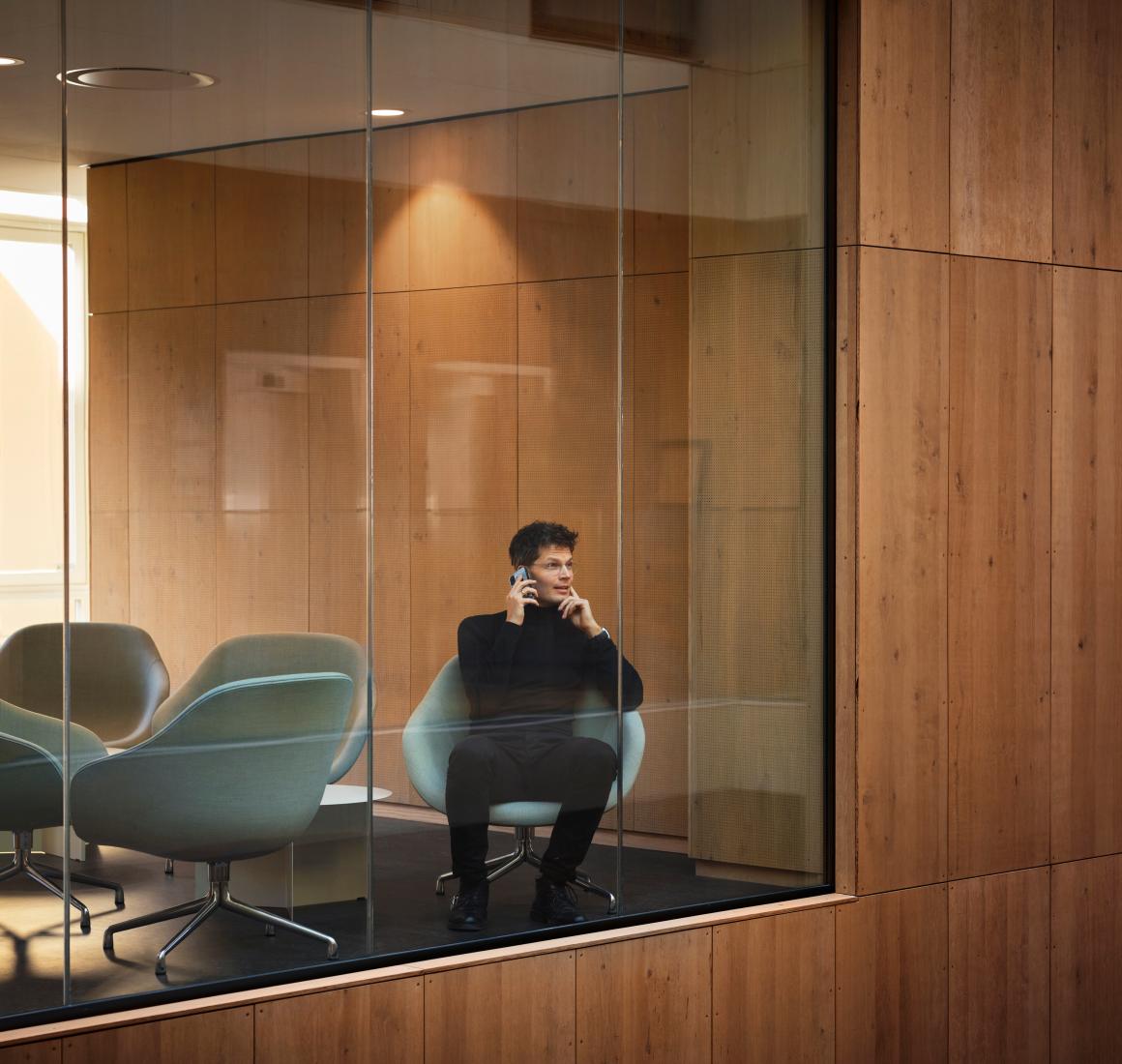
Curiosity is even more important than expertise
Why rethink education amid rapid change in work, climate, and worldview? Why not stick to “business as usual”? And why value curiosity over knowledge? Rane Willerslev offers no simple answers – but real hope – if more people stay open, adaptable and ready for change, whether we like it or not.

Rane Willerslev was the wild adventurer of all of Denmark. Until he changed his life to become head of the National Museum in 2017. Was it a big change or a natural development for the anthropologist with the pronounced desire for freedom?
“It was a necessity. I simply believe that I can lead the National Museum better. It's tough and difficult, and I certainly don't think it's a job for everyone. The bad managers are not bad people. But the best manager has both a professional understanding of the institution he has to lead, while also being able to rise above his personal prejudices," says the director and continues:
"The National Museum must be a pillar in the Danes' consciousness. It is a task I feel called to. I don't want to be a leader for the sake of being a leader. It is not power that drives, and I could never be the right director of Stryhns Leverpostej.”
So how does the professor of anthropology and the wilderness hunter go about his leadership role if it is the professional calling that drives him? “My own management style is egalitarian and inclusive. And it's certainly not the easiest way to lead. If I want to make a reform, I can't pull an idea over people's heads. I have to involve my board, middle managers, employees and unions first and hear all their critical input. And when I have made a strategy, I have to go through the whole process again.”
Therefore, Rane Willerslev has also had his own and the employees' concrete change and development in mind since he took the director's chair at the National Museum.
"We have already run an internal course where all the managers learned to make a concrete business plan. It puts things into perspective when we don't just have to deal with our own interests and areas of expertise, but when everyone also deals with the larger goals and scope, such as expenses and visitor numbers."
Does this sound like an optimization exercise or excel sheet logic? Make no mistake. Rane Willerslev, who in the spring of 2019 published the book "Backbone and Space - An introduction to a more courageous concept of education", likes to take the lead in order to show how change and education, management structure and employee autonomy are not contradictory concepts, but rather mutually dependent dimensions that used correctly can lead to job satisfaction, productivity and money on the bottom line.
“But the colleague who doesn’t want to participate in promising a new strategy or has not understood that change is a basic condition in our society is not a colleague. He or she is dead weight.” Rane Willerslev
Director of the National Museum

We need a new concept of education
There are no woolly statements or politically correct musings that are aired as surprising truths or silly philosophy. Rane Willerslev wants to be challenged. It has been the driving force throughout his life, and therefore it is natural to start by challenging him with the title of his latest book. Because hasn't the whole term "formation" just become the elite's new buzzword, after we have talked about "disruption" and "fake news"?
"If you go back a few years, education was such a dogmatic and dusty quantity that no one wanted to lean on. But yes, it has probably become a buzzword. And I actually see that as something extremely positive," says Rane Willerslev.
The museum director believes that it is when we revive education as a crucial cultural project that we create a decisive counterbalance in an economy-focused time, where all culture-bearing institutions – including museums and universities – are measured and weighed on productivity and financial goals.
“The problem with the traditional view of the concept of formation is that it intuitively excludes a large group of people. There is a huge group of people who feel that they are not part of the formed clique, and that the formation is difficult to acquire, or a knowledge you are born with," says Rane Willerslev and continues:
"There is therefore a great need for us to rethink the concept of education. And here is my suggestion that it should consist of two core elements. One is backbone. You must know where you come from, your history and heritage. It is the immersion that is being lost. The second element is spaciousness. It is the element that must destabilize the spine. There are so many theories and ideas that we have today made part of our canon, but that were wild, surprising and encountered
lots of resistance when they were introduced. Just think of Darwin and the theory of evolution that destabilized an entire worldview. We must be much more open to the destabilization that comes with new knowledge. If education is all about rote learning and reciting the right poems, and you never let yourself be challenged, then it will be the emperor's new clothes.”
The established elite has a legitimacy challenge
Rane Willerslev does not just speak as the former professor of anthropology with a PhD. from Cambridge who wants more people to visit his own museum. He also speaks like the boy who didn't visit the National Museum because his parents didn't think there was important childhood learning to be gained there. The parents were left-wing intellectuals, and they saw the museum as a "manifestation of a slightly renegade, bourgeois concept of education".
says Rane Willerslev.
It was Rane Willerslev's grandmother, who was a factory worker and the daughter of a single mother, who understood the grandson's fascination with the place, and who took him along weekend after weekend. Because it requires neither an academic education nor a student cap to appreciate our rich cultural heritage.
But if the cultural battle in the 1970s was about political dogmatism, and if ten years ago it was about judgment of taste and creating a cultural list of facts in the form of a "canon", then what is the cultural battle about today?
"It is about the fact that in the Western democracies an abysmal contradiction has emerged between the people and the elite, the 'mob' and the 'well-educated'. Trump has become the entire symbol of the polarization we are experiencing. We are in a situation where the established cultural power is being challenged by a huge group of people. Unfortunately, the elite has fallen into a dangerous reaction, which can be dismissed with a 'they are idiots' reaction," says Rane Willerslev worriedly.
"There is a broad population group that is dissatisfied and wants the system to change because it does not address the challenges facing today's individuals. The elite orient themselves too much to the problems of the 20th century, and they think they can find the answers there. But they forget that there have been radical changes in relation to our time's climate, massive migration and great social inequality."
It is not the first time that we have seen a major battle of values unfold. But where the warring parties during the industrial revolution fought over the distribution of goods, resources and privileges, the fight today during the revolution of digitization is about spiritual legitimacy, according to Rane Willerslev:
"The established elite faces a legitimacy challenge. The class struggle was a struggle for resources. Today there is no middle class that is starving and dying. On the other hand, it is their entire world view that is not accommodated," says Rane Willerslev.
And he recognizes that the algorithm-driven news flow of our time poses a huge problem, because we are often only confirmed in our own preconceived notions and attitudes when we want to seek new knowledge and insight. So how do we avoid cultural echo chambers?
"Voices of discontent have gained a new place on the cultural agenda because the Internet has changed the premises for sharing news, and this has led to the fall of experts. Previously was
it is reserved for the few to define truth. Today, the truth is liberalized and democratized, for better or for worse," says Rane Willerslev and continues:
"But this is where the responsibility of the big cultural institutions comes in. They can challenge attitudes by challenging the differences between the elite and the popular."
And the director himself has taken the lead when it comes to putting action behind words. He likes to put his face and shoulders to a regular shitstorm to live up to his own educational code. That is why it was also completely natural to say yes when Jim Lyngvild, the self-taught Viking aficionado, style debater and provocateur, offered his assistance to the National Museum's large Viking exhibition, "Meet the Vikings".
"Jim Lyngvild is not a professional. He is an enthusiast. Therefore, he understands the popular dimension that an audience magnet must also have. Of course, his approach to the exhibition cannot stand alone, but when his wildness is paired with the professionalism of three experts, you create an experience that resonates with far more people. We have never had such a large number of visitors to a single exhibition that at the same time cost so little money to set up.”
Change is the basic condition of the modern world
Rane Willerslev himself is not afraid of change. A shitstorm is a small price to pay in a working life where he likes to travel to Uganda to carry out field work, almost dies of hunger and cold in Siberia or simply tries his hand at the elite's unwritten rules at a university in Cambridge. It is not anxiety-provoking change that he fears, but rather a killing culture of monotony and bureaucracy. So what if he could challenge the status quo somewhere else in society. Where would it be then?
"The public sector. Without hesitating. I see the way the public sector is run today with control, top management and management regime as the biggest threat to our welfare society. Right now, the entire public sector is based on employees feeling a 'calling' to be nurses or teachers. Because it is neither salary, status nor job security that can pull," says Rane Willerslev and continues:
"The vast majority would like to live out their dream if they are allowed to, rather than document and record time."
We must seek out the unknown
But isn't it understandable if more and more Danes can feel a certain loss by constantly being told that "change is coming"? That we can just wait, because climate, human outlook and the labor market as we know it will be completely different in just a few years?
“I do not deny that change can be hard. This is actually one of the things I discuss a lot with Svend Brinkmann [professor of psychology, author and debater, ed.], when he consistently chooses to wear the hat of no. Because you can easily say that you want to stand firm and not budge when it is a meta-reflection that you are doing as a professor. But the colleague who does not want to help lift a new strategy or has not understood that change is a basic condition in our society, is not a colleague. He or she is dead weight.”
The National Museum director believes that the great fear of change has not arisen from a reluctance to change, but because the process of change with the digitization of our society has sped up the process so much that our brains cannot keep up.
"We must not return to museums being dead places with showcases and silence. And we must stop constantly feeling that we can only receive benefits from the welfare state. Instead, we must see how we can support our welfare state, help develop it and give back to it.”
Rane Willerslev also reaches outside the framework of the National Museum to find allies who will help bring the wild change into the structured framework of education.
But what type of employee would the museum director himself pick out of the pile of applications. Does he think that curiosity is more important than professionalism?
“Yes, damn it! Professionalism requires that you master an area, but professionalism can also make you dogmatic and algorithmic. Curiosity drives you towards that which you do not understand. I would always prefer to have colleagues who are not done seeking out the unknown. And who would rather ask permission than forgiveness.”
Keep reading

Not everything has to be a success to ultimately be decisive for the strategy
Uniqlo has cracked the code to success
What it costs being dismissed as CEO
Stay updated on MBD
Sign up for our newsletter and receive our newest research, podcasts and event invitations in your inbox. We send out 6-8 newsletters a year.
Keep learning
Master of Business Development
Executive MBA