Aesthetics and Business Innovation: Rethinking Leadership and Creativity
Innovation demands creativity. Business leaders might achieve greater success in fostering innovation and creativity by drawing inspiration from the world of arts and aesthetics, which embraces the unknown.
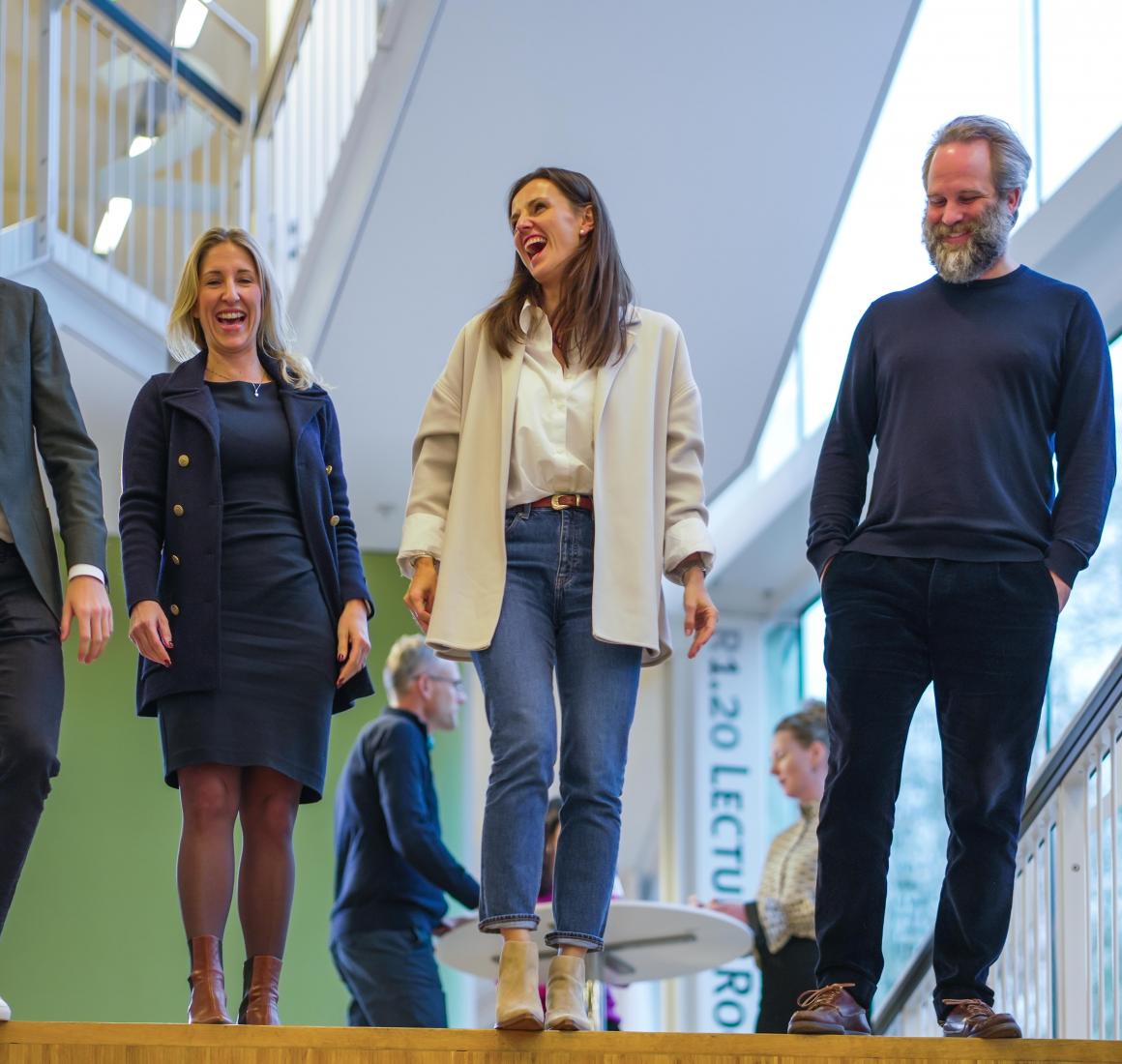
On Thursday, 20th February, CBS Executive Education hosted a compelling event titled Aesthetics and Business Innovation: Rethinking Our Approach. As the sun set over a crisp Copenhagen afternoon, experts Daniel Hjorth and Roberto Verganti, alongside a thought-provoking panel, consisting of Ana Maria Munar, Silviya Svejenova and Christian Bason offered fresh insights on how organisations can transform leadership and decision-making by embracing the often-overlooked world of art and aesthetics.
This event wasn't just a presentation on innovation - it was a call for leaders to step outside the traditional confines of business management and embrace ambiguity, uncertainty, and creativity as powerful tools for growth. The discussions challenged us to rethink how we lead, make decisions, and foster innovation. What emerged was an argument that the most significant innovations come not from structured processes, but from the courage to navigate the “in-between.”
Embracing the 'In-Between': A New Space for Innovation
One of the most striking themes of the evening was the idea of the "in-between" - the uncertain, ambiguous space that often lies between setting a goal and achieving it. Daniel Hjorth introduced the metaphor of shooting an arrow, where the start (loading the bow) and end (hitting the target) are clear, but the mid-air process - the flight of the arrow - is what remains largely unexplored in traditional management practices. He applied this metaphor to the business context, highlighting how this 'in-between' space is often overlooked in management, but it's where art resides and where ambiguity can lead to greater creativity and innovation.
Business leaders are often trained to focus on the beginning and the end of a process. The start is about setting goals, and the end is about measuring success or failure. But the "mid-air" moment, the space where creativity and meaning unfold, is often ignored. As Hjorth argued, embracing this phase is where true innovation can happen. It is this willingness to stay in the "in-between," to tolerate uncertainty, that can unlock deeper creativity and more transformative results.
Verganti’s perspective reinforced this idea. He suggested that the reason many design-thinking methodologies fall short is that they focus too much on problem-solving and too little on meaning-making. In his view, art doesn’t provide solutions, but it helps us find meaning. When leaders take inspiration from art, they gain the ability to better navigate ambiguity and make decisions that go beyond simple answers.
Hear the speakers' key insights from the event
Hear Daniel Hjorth and Roberto Verganti discuss why incorporating aesthetics is crucial to Scandinavian and European businesses. Recorded at the CBS Executive Education event 'Aesthetics & Business Innovation: Rethinking our Approach'.
The Courage to Lose Control
Both Verganti and Hjorth made it clear that embracing the "in-between" requires a certain kind of courage - the courage to lose control. Traditional management practices thrive on predictability, clear metrics, and outcomes that can be measured. But innovation, as the panel discussion revealed, often flourishes when we relinquish control and enter the murky waters of uncertainty.
Verganti linked this to the work of a doctor, whose skill is not measured by the number of patients they cure, because we all end up dying at some point anyway. Instead, they can be measured by the care they provide during the process of treatment. In the same way, leadership should not be measured only by the end result, but by how well leaders guide their teams through the uncertainty, the ambiguity, and the "in-between" moments of innovation.
This concept of losing control is a hard pill for many organisations to swallow. As the panellists pointed out, many companies avoid experimentation because they fear the unknown. They hesitate to venture into the "in-between" because they don’t know where it will lead. Yet, it is precisely this willingness to stay in the unknown that can result in breakthroughs.
Hjorth, drawing on the etymology of the word "entrepreneur" (from the Latin "between" and "to take"), underscored the idea that entrepreneurship, like innovation, thrives in this uncertain, in-between space. It is in the intersection of invention and action where true innovation happens - if we have the patience to stay there long enough.
Aesthetic Thinking as a Driver of Innovation
Another crucial insight from the event was the role of aesthetics in fostering innovation. Aesthetics, as discussed by Hjorth, is not merely about beauty or art for art's sake; it’s about the experience, the engagement, and the questions that arise from it. It’s about how art makes us feel and think, often in ways that defy immediate interpretation.
In the corporate world, aesthetics is often sidelined as a peripheral or "cultural" activity. Yet, as both Verganti and Hjorth pointed out, we are constantly impacted by aesthetics - whether through design, the spaces we inhabit, or the ways in which we communicate. When aesthetics is incorporated into business thinking, they have the power to challenge our assumptions, ask new questions, and inspire deeper exploration. This kind of thinking doesn't lead to predictable outcomes, but it does foster an environment where new ideas can take root.
Looking Forward: Embracing the Uncertain Space of Innovation
A key question that arose during the event was whether it’s possible to teach leaders to navigate the uncertain "in-between" space where creativity thrives. Daniel Hjorth answered: “The magic will always escape when packing it together and teaching it. But I believe that we will see great results if we try.” This highlights the inherent challenge of teaching creativity and ambiguity - qualities that defy structured frameworks or formulaic solutions.
Nevertheless, the conversation underscored an important truth: while creativity itself may not be something that can be directly taught, organisations can create environments where it can flourish. Leaders may not be able to hand their teams a roadmap for navigating uncertainty, but they can foster a culture that encourages experimentation, risk-taking, and openness to failure. This approach, in turn, can lead to more innovative, flexible solutions that move beyond rigid processes.
Looking ahead, the future of business innovation lies in embracing these uncertain spaces. Too many companies hesitate to experiment, fearing the unknown and the lack of guaranteed results. Yet, it is through play and experimentation, through venturing into the “in-between,” that true breakthroughs occur. By challenging the status quo and welcoming unpredictability, leaders can unlock new avenues for growth and creativity. The call to action is clear: we must learn to navigate uncertainty and let aesthetics, art, and creativity guide us toward a more innovative future.
These insights were shared at a CBS Executive Education event
Explore our offering of events here
KEEP READING

The reign of transformation and potentialisation in organisations

Leadership in the Age of AI: The 3 Phases – Curiosity, Usefulness & Normalisation
AI Success Begins with Leadership's Mindset
When leadership quality declines, employees’ depressive symptoms increase
Your gateway to more knowledge
Did you find this content interesting? Sign up for our newsletter and gain access to more of our research findings and events.
With the world’s grand challenges awaiting us, we need to continuously evolve, gain new knowledge and insights, and upskill.
Dive into a world of knowledge by signing up below. You will get:
- Personal event invitations
- Pertinent research-based insights on business and society
- Information about the next intakes of our Executive Education programmes and courses
KEEP LEARNING

Managing Innovation
Forretningsudvikling

Master of Business Development