"Leadership development doesn't always have to feel good"
At a time when leadership development is often reduced to tools and quick fixes, a different perspective is emerging. CBS Associate Professor Eric Guthey and CBS Assistant Professor Nicole Ferry are at the forefront of this shift, reframing leadership as a relational, reflexive – and sometimes uncomfortable – practice.

“Leadership development doesn’t always have to feel good. If you leave feeling great, we’ve probably not done our job. Some of the best learning comes from discomfort.”
The conclusion comes from CBS Assistant Professor Nicole Ferry, who researches gender and equity in leadership development. Together with Associate Professor Eric Guthey, who studies leadership development and the cultural production of leadership, they work in the intersection of research and practice, challenging conventional ideas of what leadership development should deliver.
Shifting from leader to leadership
At CBS, and in their collaborations with organisations, Eric and Nicole draw directly on their research when designing and facilitating leadership development. Rather than offering participants a set of ready-made tools or step-by-step models, their work focuses on building critical reflection, questioning assumptions, and exploring leadership as something that emerges in relationships rather than residing in individuals.
Through concrete examples from their work with companies, their approach illustrates a broader point: research does not have to remain abstract or removed from practice. On the contrary, it can play a crucial role in reshaping how leadership is understood and developed by opening new perspectives, challenging bias, and creating space for more thoughtful and reflexive leadership in practice.
“The leadership development industry has a central organising principle: the leader. It is really leader development, not leadership development. But leaders leave. Leadership cultures and interactions can stay.” Eric Guthey
CBS Associate Professor
Leadership begins by challenging assumptions
One of the first things Eric and Nicole do, whether in a classroom, in corporate setting or at their leadership development workshops, is to unsettle participants’ assumptions about what leadership is:
“When we ask, ‘What is leadership?’, people don’t answer the question. Instead, they describe who they think are great leaders. So, we unpack with them why they do that: people generally personalise leadership and take on so much responsibility in their own leadership that they think they must be like these figures. But nobody can be like the people they describe. Instead, we show them that leadership is also something you can do together,” Eric explains.
That shift, from leader to leadership, is not just conceptual. It fundamentally shapes how Eric and Nicole design their training and workshops:
“We show them that leadership doesn’t have to sit within the individual person, but can be a set of relationships,” Nicole says. “And that is why we try to design the workshops in the most relational and dialogic way we can. We don’t do individual personality tests, because it simply doesn’t reflect our research or the most cutting-edge leadership research today.”
Leadership as a relational practise
Instead of focusing on the individual, their sessions are built around interaction, reflection, and shared experience:
“We’re largely trying to get people to collaborate, interact, or do some kind of embodied work with one another,” Nicole continues. “Because that is what developing leadership actually looks like.”
This approach often runs counter to what organisations expect when they invest in leadership development.
For Eric and Nicole, this is where research makes a difference – not by simplifying, but by adding layers of understanding:
”People expect tools they can use the next day,” Eric says. “That is understandable. But people are already flooded with tools. What they need is the critical capacity to understand the assumptions behind those tools and the ability to pick and choose between them.”
To Nicole, the point is equally about how leadership is understood in practice:
“We try to develop critical reflexivity: the idea that how you see the world and how the world sees you is constantly sort of the result of power relationships and social identities and institutions.”
In practice, Eric and Nicole tries to trigger aha moments through deceptively simple exercises:
“We like to start with that ‘what is leadership’ activity. We get them to give off-the-cuff answers, and then we reflect it back to them. That is often the first moment where they realise: where does my understanding of leadership come from? And once people start sharing their experiences with one another, that is where you see the critical thinking happening and the development happening between people”, Nicole explains and adds another example:
“We also do an exercise where men are asked questions that women typically get in interviews. And it’s not until you switch it that they realise how absurd it is. They feel it and that is when they understand how gender and power work.”
“If there’s not a bit of discomfort happening, then something is missing. Some of the best learning comes from situations that are troubling or unsettling.” Nicole Ferry
CBS Tenure Track Assistant Professor
Beyond tools: what leadership development is missing
To Eric, these kinds of experiences point to a broader issue in how leadership is commonly understood - and sold:
“The leadership development industry has a central organising principle: the leader. It is really leader development, not leadership development. And it’s a smart move, because if I tell you it’s going to make you a better person, you’re going to buy my product. But leaders leave. Leadership cultures and interactions can stay.”
This is also why both Nicole and Eric are cautious about promises of quick impact:
“We can’t know what people do afterwards. We can’t tell them what to do. But we can help them understand the position they’re in and what they’re expected to do,” Eric says.
And yet, despite the lack of easily measurable outcomes, both point to subtle, but meaningful effects. As Nicole explains:
“When participants report back that they now do something differently, that matters. If you can change how, you see the world, that can have a ripple effect on how you act and, on the people, around you.”
Learning from the unsettling
At a time when organisations are facing increasing complexity, including geopolitical shifts and a quantum leap in AI, their research offers a different way of understanding what that means, Eric says:
“Complexity is not just about technology or AI. It’s about what our friend Professor Mary Uhl-Bien calls rich interconnectivity. You have to deal with people every day, and you never know what they’re going to do. But when you interact with them, you change them and yourself. This is really what complexity is.”
Which brings them back to where they started: leadership as something relational, situated - and not always comfortable:
“If there’s not a bit of discomfort happening, then something is missing”, Nicole explains. “Some of the best learning comes from situations that are troubling or unsettling and something is stirred up in you.”
It is, as Eric and Nicoles works shows, a discomfort that is not incidental, but central to how leadership actually development works – and probably always has.
About the researchers
Eric Guthey is Associate Professor at Copenhagen Business School’s Department of Management, Society and Communication, where he researches leadership and leadership development with a focus on the cultural production of leadership. Eric has extensive experience in executive education, including at the Baltic Management Institute’s Executive MBA programme. Eric Guthey holds a PhD in American Culture from Emory University and an MA in Religion/Religious Studies from Columbia University.
Nicole Ferry is Tenure Track Assistant Professor at Copenhagen Business School’s Department of Management, Society and Communication, where she researches gender and equity in leadership development and how leadership practices reflect and reproduce norms around gender, power, and (in)equity, a work that Nicole practice with organisations and businesses. Nicole has previously held academic positions at City University of Seattle and Washington State University.
These insights were shared at a CBS Executive Education event
Explore our offering of events here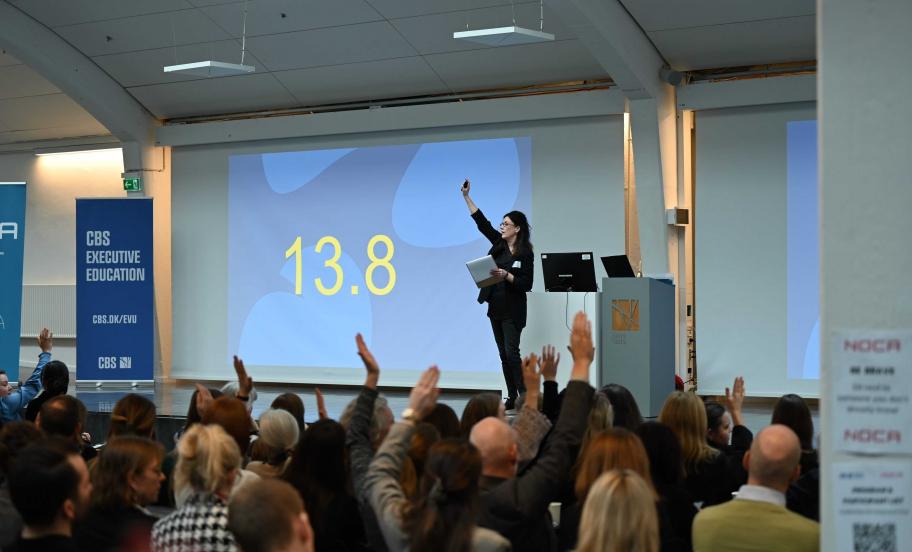
KEEP READING

Becoming a responsible leader
We recently brought together Andrew Mellor (MBA Admissions Manager) and Alistair Edwards, MBA alum & Associate Global Portfolio Director at Novo Nordisk,…

Når topchefer græder – om psykologisk tryghed og følelsesmæssig ledelse
Følelserne har indtaget arbejdslivet, og topchefer er i dag forpligtede til at tage højde for medarbejdernes sårbarhed. Men forskning viser, at kravet om at…
Hvordan deler man ledelse i praksis? – Erfaringer fra en organisation i forandring
Opfattelsen af ledelse har ændret sig fra at være en medfødt evne hos den enkelte, til noget vi i dag er ansvarlige for sammen. Men hvor stiller det…
Det næste skridt i AI: udviklingen af et agilt mindset
Udforsk skiftet fra at lære at implementere AI-værktøjer på en daglig basis til at fremme ledelse, teams og organisationer, der er forberedte og dygtige til at…
Your gateway to more knowledge
Did you find this content interesting? Sign up for our newsletter and gain access to more of our research findings and events.
With the world’s grand challenges awaiting us, we need to continuously evolve, gain new knowledge and insights, and upskill.
Dive into a world of knowledge by signing up below. You will get:
- Personal event invitations
- Pertinent research-based insights on business and society
- Information about the next intakes of our Executive Education programmes and courses
KEEP LEARNING
Executive MBA
CBS EMBA’s unique programme design and real-world applicability provides the platform for you to navigate a turbulent global business environment and become a…

HD2 Organisation og ledelse
Få et uvurderligt udgangspunkt for at løfte dit faglige niveau og bliv nøglespillere i at lede udviklingen af nutidens og fremtidens organisationer.
Strategic Communication
Learn to manage leadership and crisis communication and create effective campaigns - enhance your communication skills to drive real change in your organisation.