The hidden drivers of the gender career gap
Researchers and business leaders point to parenthood, workplace structures and policy frameworks as drivers of the gender career gap. In Denmark, two-thirds of the wage gap can be explained by observable factors – one-third remains unexplained.

Gender inequality in the labour market rarely appears at the beginning of a career. Instead, differences between men’s and women’s careers tend to emerge gradually as working lives unfold. Promotions, pay trajectories and leadership opportunities often begin to diverge over time, a development that researchers increasingly link to a complex interaction between labour market structures, family dynamics and institutional incentives.
Understanding these mechanisms is the focus of research by Annaïg Morin, Associate Professor at the Department of Economics at CBS, who recently received a grant from The Independent Research Fund Denmark for a five-year project examining the gender career gap, occupational segregation and career progression. The project draws on insights from labour economics.
“The goal is to apply worker–firm matching and job mobility insights to the question of gender inequality to better understand why we observe occupational segregation and why we observe differences in career progression between men and women,” says Annaïg Morin.
A career gap that grows over time
According to Annaïg Morin, the gender career gap cannot be reduced to a simple question of unequal pay.
“The gender career gap refers to the systematic difference between men and women in labour market outcomes over the course of their careers. It’s not just about differences in pay, but differences in earning trajectories over time, differences in promotion, in leadership roles, in access to high-paying firms and high-paying occupations, and in career interruptions," says Annaïg Morin.
Looking at Danish wage data across age groups illustrates how the gap expands as careers progress. Among younger workers aged 16 to 19, the difference in hourly wages between men and women is relatively small – around five percent.
“But if you look at older workers, in the categories of 40 to 49 and 50 to 59, we have a wage gap that is between 14 and 16 percent. Something is happening over the working period,” says Annaïg Morin.
She also emphasises that much of the wage gap in Denmark can be explained by measurable labour market characteristics.
“In Denmark, around two-thirds of the wage gap can be explained. It can be explained mostly by differences in occupation, industry, experience and education. Men tend to work in occupations that pay more, they tend to work in industries that pay more, and they tend to have more experience. One-third is unexplained by these observable characteristics,” says Annaïg Morin.
In this interview, CBS Associate Professor Annaïg Morin speaks on the circumstances enabling the gender career gap, meanwhile Head of Group Sustainability at DFDS Sofie Lindegaard shares insights from their work with diversity and inclusion at DFDS.
Care responsibilities and the child penalty
One of the most widely discussed explanations is the so-called child penalty – the decline in women’s earnings following the birth of the first child.
For Manuel Alvariño, post doc. at the Department of International Economics, Government and Business at CBS the biggest driver of the gender career gap, based on his research, basically is the child penalty.
“It is not only the fact of children. It is also about the division of labour between productive and reproductive work,” says Manuel Alvariño.
Women continue to carry a disproportionate share of unpaid care work.
“The fact that women take more of these responsibilities than men has a big impact on career progression and on the gender gap when it comes to paid and recognised labour,” says Manuel Alvariño.
Workplace dynamics and recruitment
Structural conditions within organisations also shape career opportunities.
For Sofie Lindegaard, Head of Group Sustainability at DFDS, gender imbalance partly reflects the structure of certain industries.
“I see it very much in two different ways. We have a large group of employees who work in what we call non-office positions – seafarers, truck drivers and terminal workers,” she says.
In these sectors, the challenge often begins with the talent pool.
“There are very few women that work within that field at all. So, one of our main challenges is how we attract more women to those specific jobs,” says Sofie Lindegaard.
But gender dynamics also appear in office-based roles, where career decisions may rely heavily on experience.
“In many cases, we tend to focus more on experience than on potential. If we focused more on potential and on a forward-looking perspective rather than only looking backwards, that could help us make better decisions about career paths,” says Sofie Lindegaard.
For her, addressing these structural challenges is also about organisational development.
“If we want to create more balanced leadership pipelines, we also need to look critically at how we define experience and potential. Otherwise, we risk overlooking qualified candidates,” she says.
Research also suggests that pay differences may partly be shaped by managerial dynamics inside organisations. Studies indicate that male managers tend to reward male employees more generously than female employees. However, the same pattern is not observed among female managers.
Because men still hold a large share of leadership positions, such dynamics can reinforce existing gender inequalities in pay and career progression.
Key statistics
Wages
EU Pay Transparency Directive (Implementation by 7 june 2026) requires employers to provide salary and gender pay information, richer pay gap reporting, and proactive transparency. Today, women earn about 12 to 13 percent less than men, on average.
Education
Since 2017, more women have long-cycle higher education degrees than men.
Female leadership
In 2025, in the 1000 largest Danish Companies 9 percent of CEOs are women and 21 percent of the board members are women. In the Global Gender Gap Report 2025, from the World Economic Forum, Denmark ranks 14th out of 148 contries. However, on the LEADERSHIP subcategory (Legislators, senior officiales, and managers), Denmark ranks 84th.
Education and labour market outcomes
Gender patterns are also visible in the relationship between education and labour market outcomes.
According to Stina Vrang Elias, founder and managing director of the independent think tank DEA focusing on early childhood, education, research and innovation, gender patterns in education have shifted significantly in recent decades.
“What we’re seeing in Denmark is that boys are lagging behind. Girls often perform better in school and achieve higher grades. But when we look at the labour market, girls are not taking the money or the power that corresponds to the competences that they have,” she says.”
For Stina Vrang Elias, the explanation is not only structural but also cultural. She argues that deeply embedded norms about gender roles still shape expectations about work and family life.
“In Denmark we like to think of ourselves as a very progressive country, but in many ways we are still quite gender nostalgic,” says Stina Vrang Elias.
According to her, these cultural expectations often become particularly visible when women have children.
“In my own experience, the most difficult moment in staying on a career track was when I had children,” says Stina Vrang.
She recalls that reactions from people around her often reflected different expectations for men and women.
“When something good happened in my career, people would often ask: ‘But what about the kids?’ My husband, who is a professor, was never asked that question,” she says.
Policies shape choices
According to Manuel Alvariño, public policy also plays an important role in shaping family decisions and labour market outcomes.
“It is not only about people’s preferences. Policies and regulations affect behaviour, incentives and employer expectations,” he says.
In interviews with young fathers, Manuel Alvariño has observed how institutional structures influence parental leave decisions and how economic incentives can shape the outcome.
“If parental leave were paid at 100 percent across all sectors, the difference in parental leave between men and women would likely be smaller,” he says.
A more radical measure would be to make parental leave fully equal for both parents.
“If we establish equal parental leave for both parents, this forces people to have a more egalitarian family life,” says Manuel Alvariño.
“In Denmark we like to think of ourselves as a very progressive country, but in many ways we are still quite gender nostalgic.” Stina Vrang Elias
CEO of Tænketanken DEA

The economic case for closing the gap
For Annaïg Morin, the gender career gap ultimately reflects a combination of structural, institutional and cultural factors, and there is no single root to it. And, unfortunately, there is also no single policy fix.
For her, the gender career gap is not only a question of fairness but also of economic efficiency. From an economic perspective, persistent gender inequalities in the labour market may lead to what economists describe as a misallocation of talent.
“When women do not have the same opportunities in the labour market, it means that talent is not used where it is most productive,” says Annaïg Morin.
“It can lead to lower aggregate productivity growth and less innovation, because the labour market remains segregated and women do not have the same opportunities as men,” she says.
At the same time, Annaïg Morin emphasises that the goal should not necessarily be to eliminate every difference between men’s and women’s careers.
“Some degree of gender differences may remain. Eliminating the gap entirely is not necessarily the right objective. The right objective should be to reduce the gap that is caused by structural barriers, distortions or unequal opportunities,” says Annaïg Morin.
These insights were originally shared at a CBS Executive Education event
Explore our offering of events here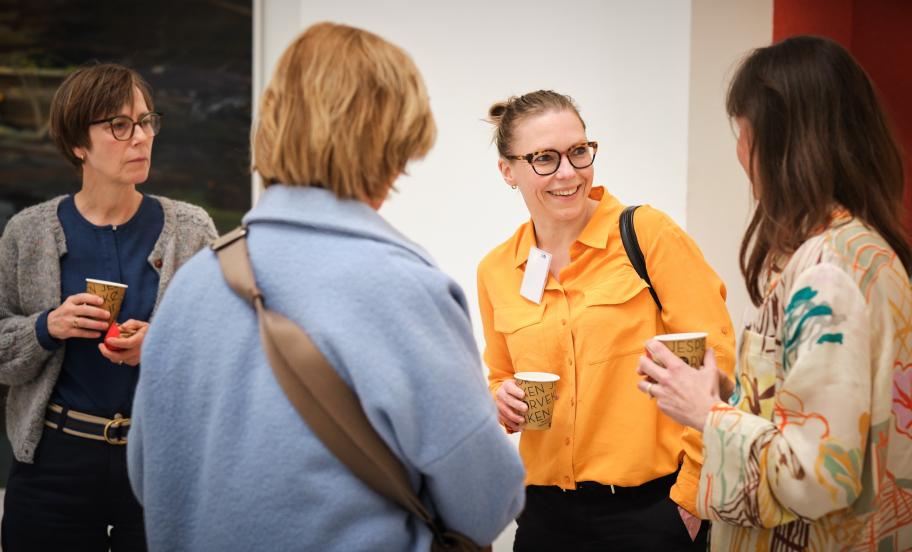
Keep reading


Your gateway to more knowledge
Did you find this content interesting? Sign up for our newsletter and gain access to more of our research findings and events.
With the world’s grand challenges awaiting us, we need to continuously evolve, gain new knowledge and insights, and upskill.
Dive into a world of knowledge by signing up below. You will get:
- Personal event invitations
- Pertinent research-based insights on business and society
- Information about the next intakes of our Executive Education programmes and courses
Keep learning

Ledelse af diversitet og inklusion
Bliv bedre til at sikre mangfoldig repræsentation i ledelse og fagspecifikke grupper og få værktøjer til at lede diversitet på en måde, der fordrer en…

Organisationer i praksis
Få et helhedssyn, der involverer dig i ledelses- processer. På kurset lærer du at se din organisation i et nyt lys og se potentielle handlemuligheder.

Full-time MBA
Elevate your career with a triple-accredited one-year Full-time MBA programme built around sustainability, authenticity and innovation.