Department of Business Humanities and Law
At BHL we tackle the big questions shaping business and society today. Through high-quality research and teaching grounded in the humanities, social sciences, and law, we explore what it means to be human in a world driven by enterprise and uncertainty. We challenge assumptions. We explore new paths. And we invite you to join us in shaping change.

About the department (Panel content)
Who we are
We are one of the largest and most diverse departments at CBS placing the human at the centre of our research to tackle key challenges for organisations and society
8 Core Research Themes
3 Academic Units
120+ Employees
Insights and Events


“ Department of Business Humanities and Law is not business as usual. We are continuing a CBS tradition of not being a traditional business school but being much broader and thinking of ourselves as a business university. As such we place the humanities and law at the centre of business education and research. ” Mitchell Dean
Head of Department

Rethink Business. Reimagine Society
At the Department of Business Humanities and Law, we explore the big challenges where business meets society. Our work blends the humanities, critical social sciences, and law to understand these issues and build the skills to address them.
Our faculty span fields from entrepreneurship and leadership to law, sociology, politics, philosophy, history, and more. What connects us is a shared focus on how human life is organized in different environments — and a belief in the power of ideas across disciplines.
We aim to enrich business practice and education by looking beyond the bottom line. By exploring the social, cultural, historical, and ethical dimensions of business decisions, we work toward a more holistic understanding of organizations and their impact on people and society.
Our research shapes a wide range of CBS programs, helping students develop analytical rigor, critical and creative thinking, interpersonal skills, and the ability to collaborate — qualities essential for making a difference in today’s business world.

About Us
Strategy
BHL unites diverse disciplines to rethink the foundations of business and society. We generate knowledge that questions, transforms and empowers – preparing people and organisations to navigate complexity and shape a sustainable future.
Mission and Identity
Not Business as Usual
BHL is one of the largest and most diverse departments at CBS. We carry out critical, forward-looking research in the humanities, social sciences and law, with a strong focus on the human in society and on business and enterprise as forces of social change.
Our work spans many disciplines and crosses their boundaries. What brings us together is a shared concern for the conditions of human life and for how social and business organisations are structured and regulated. While we collaborate closely with other CBS departments, BHL stands out for the breadth of perspectives we offer and for our commitment to knowledge that addresses urgent, real-world challenges.
We draw on this wide-ranging expertise to rethink business school education and to strengthen lifelong learning in business and society. Our approach supports CBS’ overall strategy, yet remains questioning and self-reflective, engaging critically with the transformations of society, business and the human condition.
BHL is also deeply committed to research-based education. We enrich CBS’ programmes by bringing the insights of the humanities and interdisciplinary social sciences into business and society. Our strengths lie in the scope of our expertise, the depth of our scholarship and our commitment to collaboration.
Diversity, differentiation and cross-disciplinary dialogue form the three pillars of our approach to teaching and research.
History
The Department of Business Humanities and Law (BHL) builds on a long tradition. Its roots reach back to the Department of Management, Politics and Philosophy (1995), the Centre for Business History (1999), and the Department of Business Law (1952). Our current department was created after the merger of the Department of Management, Politics and Philosophy, CBS Law, the Civil Society group, and the Centre for Leisure and Cultural Services in 2018 – broadening the focus from leadership, management, politics and philosophy to wider questions of business, society and the human condition, and paving the way for today’s BHL. In 2023, it launched its new name: the Department of Business Humanities and Law – a department that brings together law, humanities and social sciences to explore business as a driver of social change.
Department Management
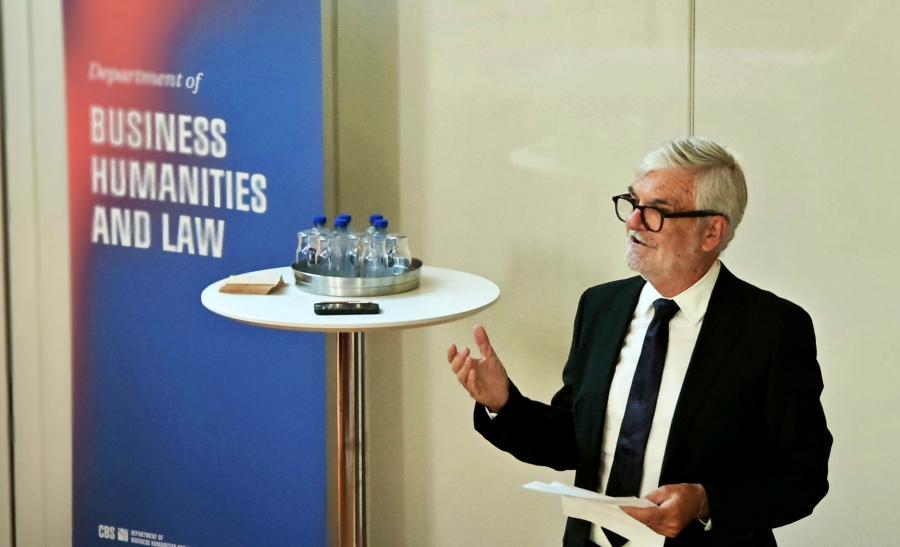
| Head of Department Mitchell Dean E-mail: mde.bhl@cbs.dk, tel +45 3815 4234 |
| Head of Secretariat Henrik Hermansen E-mail: hh.bhl@cbs.dk; tel. +45 3815 3656 |
| Vice-Head of Department (Education) Trine Bille E-mail: tb.bhl@cbs.dk; tel. +45 3815 2548 |
| Vice-Head of Department (Research) Florence Villesèche E-mail: fv.bhl@cbs.dk, tel. +45 3815 4268 |
| Director of Entrepreneurship, Ethics and Leadership Unit Christian Garmann Johnsen E-mail: cgj.bhl@cbs.dk, tel. +45 3815 4293 |
| Director of Governance, Culture and Learning Unit Stina Teilmann-Lock E-mail: st.bhl@cbs.dk, tel. +45 3815 3756 |
| Director of CBS Law Unit Henrik Andersen E-mail: ha.bhl@cbs.dk, tel. +45 3815 2632 |
Academic Units
The Department of Business Humanities and Law is organized in three academic-administrative units - all closely related to aspects of our educational offerings as well as to our research. They provide staff with a sense of home, nourishment and mentorship, and immediate workplace. They facilitate disciplinary and interdisciplinary dialogue across a wide span of related work, with a particular emphasis on a common educational focus. They also act as key resources for the formation and implementation of strategy within the department.
Centres at the department
Learn more about our research centres, where knowledge is created through research and collaboration
Centre for Business History
As historians at a business university, we explore context, time and change for business research and education.
CBS Geopolitics & Business Security
CBS Geopolitics & Business Security is a strategic initiative that provides research-based insights and new forms of collaboration, aimed at businesses, authorities, organisations, and decision-makers to help understand and address the geopolitical changes shaping companies, markets, and societies today.
Professor Anja Dalgaard-Nielsen, BHL, is Vice Dean for CBS Geopolitics & Business Security.
Societal Impact
BHL contributes to Danish and international society with our knowledge that addresses real-world challenges and opportunities. Through interactive dialogue we engage with companies, policymakers, and communities to ensure that our research and education activities create value beyond academia. By bridging research and practice, we seek to make a lasting impact on both business and society.
BHL faculty are often recruited to serve on boards and committees offering advice and research-based expertise.

Events
Research and publications (Panel content)
Research Focus at BHL
Our research brings together the humanities, interdisciplinary social sciences and law to explore the major challenges facing humanity, business, government and civil society – both nationally and internationally. We do not only aim to understand these challenges but also to identify and build the capabilities that enable key actors in society to address them. Our work engages with themes such as entrepreneurship, transnational governance, alternative forms of economic organisation, business ethics, sustainability, leadership and diversity.
By business humanities we mean the effort to understand current and future challenges to the human, society, economy and planet, drawing on the rich traditions of the cultural and human sciences. We aim to provide a world-class environment for research across business humanities and law – and to ensure that this research has a deep and lasting social impact.
Key focus areas
- Culture, Design and Creativity
- Leadership
- Transformative and Alternative Economic Organisation
- Business Ethics
- Civic and Public Governance
- Business History
- Diversity, Equity, and Inclusion
- Entrepreneurship and Social and Technological Venturing
- Organizing and Managing Workplaces
- Business Law and Society
- Law and Markets
- Climate Law and Economics
- Learning
- Business Security & Geopolitics
Publications
See all publications2026
The Corporation, Corporate Governance and the Sustainable Transition
Tessa Barnow, Ph.d. Fellow
Benjamin Ask Popp-Madsen, Assistant Professor
Mathias Hein Jessen, Associate Professor
2026
Implementing the Danish Defence Agreement Under EU and NATO Frameworks

Kathrine Søs Jacobsen Cesko, Assistant Professor
Laura Jung Gleesborg Hintz, Teaching Assistant
2026
The Corporation, Corporate Governance and the Sustainable Transition
Introduction
Tessa Barnow, Ph.d. Fellow
Benjamin Ask Popp-Madsen, Assistant Professor
Mathias Hein Jessen, Associate Professor
Our academic units
The Department of Business Humanities and Law is organized in three academic-administrative units - all closely related to aspects of our educational offerings as well as to our research. They provide staff with a sense of home, nourishment and mentorship, and immediate workplace. They facilitate disciplinary and interdisciplinary dialogue across a wide span of related work, with a particular emphasis on a common educational focus. They also act as key resources for the formation and implementation of strategy within the department.
Our Research Groups
Business Law and Society
With an approach that is focused on the cross-fertilization of business and society, this research group targets research aimed at legal framework conditions for business life. Law is an important part of business and society infrastructure, and legal research can help companies grow and innovate. Companies are critical members of global society, and their activity and achievements impact nations and lives. In the same regard, public regulation, governance and policy influence business life.
The research methods chosen are those of internationally recognized business law research: Legal dogmatic method, Law & Management, Law & Strategy and Law & Economics. Our research concerns strategic and relational contracting, business responsibility, accountability, tax and society, litigation and risk management, etc. Our research strategy also includes crossdisciplinary research in law and neighbouring research fields. Thereby, we can address complex business and society problems, offering solutions and not just answers.
Contact person:
Centre for Business History
Copenhagen Business School is committed to research and teaching that responds to current and future societal challenges. At the Centre for Business History, we foster understanding of current business phenomena by studying their evolution in time and over time. As a cross-disciplinary group of scholars focused on the role of history in a business school, we utilize a range of approaches, methods, and sources in order to produce rich, structured, humanistic accounts of the creation of current conditions - economic, social, cultural, and political - generative of future possibilities and opportunities. The Centre for Business History will work to embed historical awareness and historical consciousness at the heart of the business humanities project in terms of both research and education. History matters to the business humanities for two fundamental reasons.
The Centre for Business History will provide an environment fostering excellence in historically-oriented business school research and education with the aim of enhancing historical awareness and consciousness across society. Collegial, collaborative, and critical, the group will sharpen individual members’ research and publications whilst providing a forum for exploring future projects, individual and group. As historically-oriented scholars in the business school we will seek to provide historical perspectives on the relationship between economy and society. Principal areas of focus will include:
- historical entrepreneurship studies;
- narratives and sense-making;
- history, heritage, and identity;
- the history of capitalism.
Contact point: Andrew Popp, ap.bhl@cbs.dk.
Culture and Creativity
Culture is an important sector in society covering the arts, heritage, museums, libraries, film, music, performing arts, design, architecture, crafts and sports. At the same time, culture has the potential to transform people, business, and society, by developing transformational capabilities, fostering creative new ideas and enhancing self-reflection and self-transformation. Culture is in the crossroad between business, entrepreneurship, civil society, and government.
The Culture and Creativity Group covers various disciplines such as cultural studies, organization, history, sociology, anthropology, education, economics, management, art history, law, entrepreneurship and aesthetics.
The aims and ambitions of the Culture and Creative Group include:
- Bridging academic research and industry development: The group works in partnership with the both the cultural sector and leading foundations for culture and the arts.
- Creating collaborative culture: To develop transformative and interdisciplinary projects within research and educational programs.
- Critical reflections: Maintain and develop critical perspectives on conceptual and practical interpretations of culture
- Emphasizing learning: Bridging learning with other fields through on-going research, dialogues and explorative measures.
Themes
- Cultural and creative industries in green transition
- Valuing practices
- Materiality and Immateriality
- Cultural and creative organisations and transformation
- Innovating business models for cultural and creative organizations for society/green in transition
- Art entrepreneurship
Contact point: Trine Bille, tb.bhl@cbs.dk.
HUMAN: post-anthropocentric enquiries in business and society
Drawing on and contributing to philosophy, anthropology, and social theory, this research group studies the contemporary status of the human being in business and management.
The human question has gained new importance in light of the rise of new challenges, such as climate change and environmental crises, the demand for sustainable responses to technological and digital transformation, rapid value changes in society, as well as persistent problems of inequality and injustice. Businesses and organizations are deeply impacted by these challenges; and they carry a key responsibility for contributing with possible solutions.
Providing excellent research that helps to re-think the human dimension in business, management, and society, this research group addresses the above-mentioned challenges. Our research and teaching invite organizational scholars and learners to move beyond limited anthropocentric understandings, considering the relationality between human and non-human actors as well as the controversies in modeling human behavior in the social sciences.
Our teaching and research contribute to the following areas:
- Management learning and education, including life-long learning and philosophy of education
- Philosophy of science in business administration and applied epistemology
- Business ethics and philosophical critique of the human dimension within particular fields, including finance, tourism, leisure, work-life, and welfare provision
- The problem of the Anthropocene, including the relation between human and non-human agency and the interplay between human beings and technology
- Basic research concerning the human dimension in ethics and political philosophy, economic and political anthropology, social theory and organization studies
| Contact point | Cathrine Bjørnholt Michaelsen, cbm.bhl@cbs.dk |
JURASOC – legal, social and technology studies
The [JUH] + [RAS] + [OK] is a group of scholars who explore intersections of law, political economy and technology broadly understood. Main directions of research in the group include global value chain law, intellectual history and political theory of the corporation, information technology law, internet governance, corporate power and legitimacy, transformative capacities of corporations, law and legal design. Members of the group are united in the ambition to address challenges to business and society deriving from ongoing shifts in corporate powers and technologies. Thus, the research group will perform interdisciplinary and multidisciplinary research to yield better understandings of relationships between corporate law & corporate governance and of efficacious ways of crafting legal responses to corporate, societal and technology challenges. We will use legal theory and knowledge and social theory to gain insight into how transformative law, regulatory choices and corporate agency impact business opportunities, societal welfare and green transition.
The group will serve as forum for advancing research quality and dissemination through mutual support and exchanges leveraging intellectual development; engagement with relevant research environments and with ongoing scholarly debates and emerging policy questions relative to the intersection of economy, politics, technology and law; engagement with stakeholder environments, paper development sessions; mentoring of non-tenured staff and the collaborative pursuit of external funding.
Focus areas:
- Law and Technology
- Law and Political Economy
- Governance and collective relations
- Law and Colonialism
- Internet Governance
- Corporate Power and Legitimacy
- Cybersecurity as a human-rights issue
- Technology, Ethics and Society
- Legal Design
- Intellectual property law
- Sustainability and the sustainable development goals
- Global Value Chain Law
- Intellectual history and political theory of the corporation
- Cybersecurity
- Markets and AI-mediated data
| Contact point | Benjamin Ask Popp-Madsen, bap.bhl@cbs.dk |
Leadership and Contemporary Challenges
The Leadership and Contemporary Challenges group (LCC) explores leadership in relation to the major challenges that organizations and society are facing in the twentieth-first century. Amongst these challenges are climate change, digitalization, and a growing polarization in society.
Existing research on leadership has predominantly assumed an individualistic and heroic subject, able to take the lead on contemporary challenges and their solutions. Leadership is in this way idealized as the key to develop answers to complex societal challenges. In contrast, this research group explores how the grand challenges of our society today influence the practice and construction of contemporary leadership. By adopting a relational and processual understanding of "leadership", LCC examines how societal challenges put different demands on leadership, and how these challenges demand us to reconsider inherited understandings of the relation between leadership and action.
In doing so, the LCC research group confronts a variety of contemporary challenges with traditional leadership research, in order to show how these challenges constitute leadership in new and surprising ways. We interrogate existing ideals of leadership, such as transformational leadership or authentic leadership, not to replace them with new leadership ideals, but rather to do justice to the complexity of the new challenges that we face on an individual, organizational, and societal level. This not only enables us to locate leadership in contemporary challenges but also to challenge 'leadership' in the way we understand it today.
Focus areas:
- Creative leadership and entrepreneurship
- Leadership ethics
- Responsible, sustainable leadership
- Algorithmic leadership
- Leadership in the public sector
- Regenerative leadership
- Leadership and hybridity
- Leadership and well-being
- Leadership and diversity
- Leadership and work time reduction
- Leadership in 'leaderless' organizations
| Contact point | Bent Meier Sørensen, bms.bhl@cbs.dk |
Market Regulation
Market Regulation concerns the idea that markets left to own devices do not achieve results and that governmental intervention is needed to get desired societal outcomes. The group concentrates on the typical market regulation legal disciplines (listed below) and analyses them in a business and societal context. The group's main research method is legal dogmatic method, law & economics and EU and comparative legal method but the group draws on other disciplines. The majority of disciplines are new legal disciplines that are particularly relevant in a Scandinavian business and societal context (public procurement represents up to 20% of GDP), competition law is potential solution to the problem of platform dominance, climate law is a direct regulatory answer to the problem of climate change, state aid law answer to the challenges of whether to support companies in crisis, law & economics introduces economics to institutional analysis of law, EU law gives the analysis of how EU impacts markets in member states. Market regulation concerns a number of legal areas all under the influence of economic actors, governments, organisations, and regulation of the behaviour of all these actors.
Research topics:
- EU law
- Market law
- Public procurement law
- Competition law
- State aid law
- Labour law
- Climate law
- Public-Private law
- Law & Economics
- International economic law
- Regulation of sustainable markets and E-commerce markets
| Contact point | Christina D. Tvarnø, cdt.bhl@cbs.dk |
ORGADIVA
Through interdisciplinary research, the ORGADIVA aims to create a platform for researchers to collaborate and exchange ideas about how to build more inclusive, equitable, and democratic societies. The group is interested in exploring how new forms of organizing, work and economic systems can be created that are sustainable, just and with a civic dimension.
The group members also explore how these concepts unfold in social movements, alternative organizations, civil society, social enterprises, and more conventional workplaces. Overall, the group aims to contribute to developing research and teaching competence around leveraging diversity in the workplace and exploring the potential for building new worlds that prioritize social sustainability, innovation, and democracy, and also learn from past experiences.
Main focus points:
- Analyze and theorize models of governance and organizing that aim towards progressive and sustainable change in society, and explore the ongoing transformations of capitalism and the transitions to more inclusive, just, and democratic economic systems.
- Interrogate what is meant by diversity, equity, and inclusion conceptually and how they are organized and deployed. This includes exploring various research interests such as feminist and queer theory, leadership, social entrepreneurship, or DEI work(ers), and building competence around addressing the hidden curriculum and leveraging diversity in the classroom.
- Focus on civic governance processes, including autonomous and democratic governance, processes of inclusion and exclusion, and the role of civil society in meeting grand challenges. This supposes to look to the future put also to take inspiration from/engage with how they have been built and the consequences for the possibilities of action of today and in the future.
| Contact point | Morten Fischer Sivertsen, mf.bhl@cbs.dk |
Social and Technological Venturing
The research group on ‘Social and technological venturing’ focuses on humanistic approaches to entrepreneurship, technological development, innovation, and social change. The group draws on the humanities in emphasizing the ethical, historical, legal, and social aspects of creating new ventures, which encompasses the pursuit of new opportunities and the change processes that transform existing organizational forms. The research group explores how ‘venturing’ – doing something risky, such as creating a new firm, market offer, democratic institution, or public issue – always involves broader societal, technological, and historical forces, and has ethical and environmental consequences for the way we live our lives. In studying social and technological venturing from humanistic perspectives, the group will produce research on entrepreneurship, technological development, innovation, and social change disseminated in leading academic journals and contribute to teaching at CBS in these fields.
Research topics include:
- Entrepreneurialism in society
- Technological innovation
- Ethical, social, and sustainable entrepreneurship
- Temporal and historical approaches to innovation and entrepreneurship
- Imaginaries of technological progress and how they condition responses to environmental crises
- Social and technological venturing and political legitimacy
- Law, innovation, and entrepreneurship
- Intellectual Property Law & Legal Risk Management
- Space and how it constitutes processes of venturing
| Contact point | Christina Juhlin, cj.bhl@cbs.dk |
Externally funded projects
Global Value Chain Law (GLOBALVALUE)
EUROPEAN RESEARCH COUNCIL ADVANCED GRANT:
GLOBAL VALUE CHAIN LAW: CONSTITUTING CONNECTIVITY, CONTRACTS AND CORPORATIONS
Global Value Chains (GVCs) serves as central infrastructures of the global economy and global society. While the COVID-19 pandemic and ongoing geopolitical tensions might have been a revelation in this respect, the centrality of GVCs dates back to the dawn of colonialism.
Both historically and in contemporary times, GVCs produces profound environmental and socio-economic externalities in jurisdictions often incapable of or unwilling to effectively regulate abhorrent working conditions and environmental degradation. Hence, the question of how to legally regulate cross-border economic processes including the capability of democratically organised political processes to effectively regulate GVCs is a central legal problem within fields such as competition, contract and corporate law as well as environmental, human rights and labour law.
Until recently, voluntary soft law measures were the preferred regulatory tools in relation to GVCs. In the last few years, a decisive move towards hard national (e.g. in France and Germany) and EU regulation has however taken place thereby raising the question to what extent this changes the rules of the game.
On this backdrop, GLOBALVALUE develops a novel and systematic socio-legal approach to GVC Law. This is done in a threefold manner:
Firstly, through a historical sociological reconstruction of GVC Law going back to colonial law countering the currently dominant ahistorical approaches to GVC Law.
Secondly, through three comprehensive case studies in relation to the global pharmaceutical, wine and trade fairs industries. Spanning six continents and a dozen national jurisdictions the case studies will illuminate the effects of contemporary hard and soft law practices of GVC law.
Thirdly, through the development of a new concise conceptuality of GVC law with direct implications for our understanding of core legal concepts such as contract, legal order and economic constitutionalism.
Team
- Poul F Kjaer – Professor (Principal Investigator)
- Martin Skrydstrup – Associate Professor
- Francesco Corradini – Postdoc
- Luisa Teresa Hedler Ferreira – Postdoc
- Jacob Hjortsberg – Postdoc
- Negar Mansouri – Postdoc
- Pedro Henrique Carlos – PhD Researcher
- Alix Blanchard – External PhD Researcher
|
he project is funded by European Research Council Advanced Grant (101054237 – GLOBALVALUE). For further information, please contact Principal Investigator Professor Poul F. Kjaer, pfk.bhl@cbs.dk. |
T
Heritage in Europe (HEPHAESTUS)
HERITAGE IN EUROPE: NEW TECHNOLOGIES IN CRAFT FOR PRESERVING AND INNOVATING FUTURES
The project takes its name from the Greek god Hephaestus, from whom man learned to use fire, technology and crafts. CBS’ Department of Business Humanities and Law is leading the project, known in full as: “Heritage in Europe: New technologies in craft for preserving and innovating futures”. The aim of the project is to research, preserve and, at the same time, innovate craft sectors to deliver a cutting-edge, creative, and sustainable technology-driven economy based on cultural heritage.
The project is collaborating with craftspeople, organizations, and municipalities from Craft Ecosystems.
Copenhagen Business School (CBS) Staff
- Marta Gasparin, Associate Professor – Principal Investigator
- Marius Gudmand-Høyer – Associate Professor
- Vishv Priya Kohli – Associate Professor
- Rasmus Johnsen – Associate Professor
- Lena Olaison – Associate Professor
- Enrico Macciò – PhD Student
- Andrea Beye – PhD Student
- Lea Jacobsen – Project Manager and Research Assistant
- Margot Bustamante – Research Assistant
Partners of the Consortium
To achieve these objectives, the consortium brings together leading universities, business schools, and a private organization known for expertise in craft heritage, materials, and digital innovation.
- Copenhagen Business School (CBS)
- University of Gothenburg
- Università degli Studi di Roma Tor Vergata
- Bornholms Regionskommune / BOFA
- Università Ca’ Foscari Venezia
- Fablab Venezia
- Comune di Bassano del Grappa
- Wit Berry
See the details of the Consortium here
The HEPHAESTUS project is driven by six objectives and seven work packages
Objective 1: Develop new sustainable business models for the craft sectors.
Objective 2: Combine cutting-edge technologies with craft materials and processes to research and develop new applications and solutions for the digitization and innovation of the craft sector to improve sustainability and social innovation.
Objective 3: Explore visions for the role of craft in the future, integrating emerging technologies and contributing to the circular economy, by engaging craft communities in a participatory ideation process.
Objective 4: Develop a lifelong learning methodology and a set of innovative curricula to equip craft-makers with diverse skillsets for innovation.
Objective 5: Establish a green living lab for testing the HEPHAESTUS innovations.
Objective 6: To design and operationalize a bespoke dissemination, communication, and exploitation strategy.
Work Packages
The project is structured around seven work packages, each designed to address key aspects of research, development, and outreach in the craft sector:
WP 1: New sustainable business models for the craft sector
WP 2: Innovating craft through digital and cutting-edge technologies
WP 3: Crafting visions for the future of crafts
WP 4: Innovative training curricula for traditional craft-makers of the future
WP 5: Establishing Future Crafts Green Living Lab
WP 6: Communication, dissemination, and impact
WP 7: Management and data protection
|
Visit the HEPHAESTUS Project Website for further updates and insights into our progress. For more information, please contact Associate Professor Marta Gasparin, mga.bhl@cbs.dk |
Moral Elites (MORALITES)
European Research Council Starting Grant
Moral Elites: The Historical Positioning of Civil Society Leaders in National Moral Economies (MORALITES)
It is widely recognised that civil society organisations (CSOs) have had a vast historical impact on political institutions, processes of democratisation, social policy, and economic regulations. Scholars have emphasised the active role of self-organised citizens as a corner stone of the functioning of the public sphere, the accumulation of civic mores, political infrastructure, and the provision of services and advocacy. At the same time, research has shown the centrality of elites are central in forging settlements and compromises on key societal issues, begging the question how civil society elites have historically been involved in shaping societal trajectories.
MORALITES analyses the historical role of the moral elites of civil society and their impact on moral economies in four countries: Italy, Poland, UK, and Denmark. The project theorises the moral elites of civil society as elites that have the civic, organisational, cultural, and social resources to influence moral economies’ norms regulating economic, political, and social relations. It shows civil society elites’ composition, integration, and reproduction in selected elite spheres of society as well as the timing and content of elite strategies of conflict or compromise and these strategies’ influence on national moral economies.
The project focuses on critical and creative junctures in each of the four country cases. In these junctures, biographical data will be collected on key civil society elite individuals that will be analysed through structural-relational methods such as Multiple Correspondence Analysis to determine their position within their national field. These analyses will be integrated with topic modelling text analyses of programmatic texts by civil society leaders in order to determine these leaders’ position-takings. This in turn allows for at comparison of the four country contexts’ opportunity structures and how civil society leaders have acted as part of a moral elite in order to influence national moral economies.
The project is organized in five work packages – one for each country context and a cross-cutting work package focused on data, method, and analysis.
|
The grant Project leader |
Rethinking Entrepreneurship in Society
Rethinking Entrepreneurship is a research project at Copenhagen Business School (CBS) and generously supported by the Carlsberg Foundation. We explore the dynamic and evolving discourse of entrepreneurship, its impact on society, and its role in shaping the future. With a team of dedicated scholars, we delve deep into the question how the way we understand entrepreneurship links to our ability to address societal change and frames our thinking about society in past, present and future. As an interdisciplinary research community, we are challenging the status quo of entrepreneurship by recombining insights from various disciplines: entrepreneurship, history, law, sociology, political sciences and education. Discover the intricate details of our project and the innovative thinking that drives us forward.
|
Website Project leader For further information, please contact Professor Christina Lubinski, cl.bhl@cbs.dk |
Education (Panel content)
Our contribution to programmes and courses
At BHL we see teaching and research as deeply interconnected. Our greatest societal impact comes not only from publishing in top-ranked journals but also from the privilege of educating the next generation.
BHL’s teaching spans all levels across CBS. A central focus is the ongoing challenge of creating meaningful learning spaces. This involves developing innovative teaching methods – such as case-based learning – while at the same time sustaining the critical and imaginative traditions of the liberal arts and social sciences. In doing so, we place contemporary societal, managerial and organisational challenges at the heart of our curriculum.
We teach core courses in management, organisation, leadership and entrepreneurship, in business and philosophy and ethics, in business and law, and in service management.
Seizing the teaching opportunities of contemporary life means designing programmes that bring the outside world into the classroom. We do this by collaborating with professional partners to explore the core dilemmas of classical business disciplines from multiple perspectives, and by engaging with student initiatives that foster independent, reflective thinking.
We are also very active in pedagogical research, exploring how we teach and how we might teach differently, and sharing our experiences with rethinking learning widely.
Bachelor programmes
Curious about our study programmes? Below, you can explore some of the programmes the department is involved in.

HA(fil.) - erhvervsøkonomi og filosofi
HA(fil.) giver dig en forståelse af de udfordringer, virksomheder møder i vores komplekse…

HA(jur.) - erhvervsøkonomi og erhvervsjura
HA(jur.) handler om virksomheders muligheder og forpligtelser. Du lærer, hvordan virksom…

BSc in Business Administration and Sociology
In the BSc SOC you learn how to make responsible business decisions by combining the economic and social per…

BSc in Business Administration and Service Management
BSc SEM combines business economics and service sector studies and gives you an in-depth understanding of how…

HA almen erhvervsøkonomi
HA er en bred erhvervsøkonomisk uddannelse, der lærer dig at forstå sammenhængene i…
Master programmes
Curious about our study programmes? Below, you can explore some of the programmes the department is involved in.

MSSc in Organisational Innovation and Entrepreneurship
OIE gives you the tools to lead innovation and entrepreneurship. Through case-based and co-creative learning, you will ex…
MSSc in Strategic Design and Entrepreneurship
The MSSc SDE programme will give you in-depth knowledge of strategic design and business. You will learn methods for develop…

Cand.merc.(jur.) - erhvervsøkonomi og erhvervsjura
På cand.merc.(jur.) lærer du om erhvervsjura i Danmark og EU. Du får en specialiseret forståelse af,…

Cand.soc. i Human Resource Management
Cand.soc HRM handler om samspillet mellem mennesker, virksomheder og de krav omverdenen stil…

MSc in Economics and Business Administration in General Management and Analytics
The MSc EBA GMA programme combines business economics, strategic management, and data-driven analytics…
Executive Master Programmes
Being a PhD student in BHL
As a PhD student you focus on your project and course work in collaboration with your team of supervisors. You also become part of the staff at BHL and will collaborate with colleagues to deliver teaching and contribute to academic events and activities.
Get to know our current PhD fellows
Impact and career paths
Many of our alumni pursue careers in academia and continue their career trajectories with post.doc positions at universities in Denmark or internationally. However, our candidates have diverse career trajectory, and many find jobs in private companies, leading consultancy firms, national or local governments and agencies or NGOs.
“ As a PhD student at BHL, I receive a rigorous education and learn how to conduct research in a truly inclusive and nurturing environment. Our interdisciplinary department is home to leading scholars in their fields, with whom I work closely and have quickly come to regard as trusted colleagues. ” Sharon Kishik
PhD fellow, BHL, CBS

“ While my education and research project are at the core of my PhD journey, life at BHL is also about brief chats and long conversations by the coffee machine, shared lunches, and walk-and-talks in Frederiksberg Have. BHL is both a stimulating academic home and a supportive community that helps me develop my scholarly identity and supports my learning and growth as a researcher, teacher, and colleague. ” Sharon Kishik
PhD Fellow
PhD programmes within business humanities and law
Applying for a PhD
Please consult vacant jobs at CBS for more info about how to apply for a PhD stipend.
Alongside your CV and Bachelor and Master diploma, your application should include a well-developed project proposal. This includes among other things a clear research question, methodological reflections and a research plan.
Full information about how to apply and the different ways to a PhD can be found at CBS PhD school's website.
PhD courses
Courses
Interested in a PhD with us?
Further information about the CBS PhD programme, admission, funding, current PhD projects and PhD courses can be found at the CBS PhD school's own website.
BHL PhD Coordinator
Justine Grønbæk Pors
E-mail: jgp.bhl@cbs.dk, tel +45 3815 2857
Head of CBS PhD School
Anette Boom
E-mail: abo.eco@cbs.dk; tel. +45 3815 3662
PhD School Administration
Anja Knudsen
E-mail: ak.research@cbs.dk, tel. +45 3815 2625