Centre for Business History
As historians at a business university, we explore context, time and change for business research and education.

About (Panel content)
Copenhagen Business School is committed to research and teaching that respond to the great challenges of the business world.
At the Centre for Business History, we foster understanding of current business phenomena by studying their evolution in time and over time. As any business professional knows, the temptation of the quick fix only distorts complex decision-making.
It is our mission to explore how history and temporality contribute to a better understanding of society and business – for research, education and business practice.
We understand ourselves as historians at a business university and focus on the role and responsibility of business in and for society.
Since its founding in 1999, the Centre for Business History provides a space for open interdisciplinary exchange and explorations of what we broadly describe as "business humanities." Rather than going for the easy formula, we are curious about ambiguity.
We believe that tackling major business problems always requires "contextual intelligence," that is, a clear sense of the business environment to navigate. The value of deep business knowledge becomes meaningful when it is placed in context.
Welcome Centre for Business History
The introduction video presents the Centre for Business History and its vision to show how historical perspectives help us understand business, society and change over time.
Research and dissemination at the Centre for Business History
As a cross-disciplinary group of scholars focused on the role of history in a business school, we advance a variety of conceptual and methodological approaches to the relationship between past, present and future.
Histories that shape business and society
We study the intersecting histories of capitalism, business enterprise, entrepreneurship, politics and culture as they shape and transform the development of human societies over time.
As a Centre, our aim is to deepen historical awareness and reflexivity to grapple with the pressing challenges of human society today.
Forward-looking leadership requires contextual intelligence. Ken Chenault, former CEO of American Express, Susan Wojcicki, the CEO of YouTube, and Lloyd Blankfein of Goldman Sachs all started their careers by studying context, time and change – just like us.
It is our mission to reimagine the power of historical thinking in and for business.
Public outreach
We are featured regularly and prominently in the Danish and international media. You find us in the print press, in podcasts and on the radio. Many of us review books that are of public interest and we are open to media requests.
Contact Centre for Business History
Contact Centre for Business History
Department of Business Humanities and Law
Copenhagen Business School
Centre director: Andrew Popp
Porcelænshaven 18A DK-2000 Frederiksberg Denmark

People (Panel content)
Staff at the Centre for Business History
The Centre for Business History brings together a diverse group of scholars working on the historical dimensions of business, organisation, and society.
The staff includes professors, associate professors, assistant professors, postdoctoral researchers, PhD fellows, and teaching assistants.
Centre Director: Andrew Popp
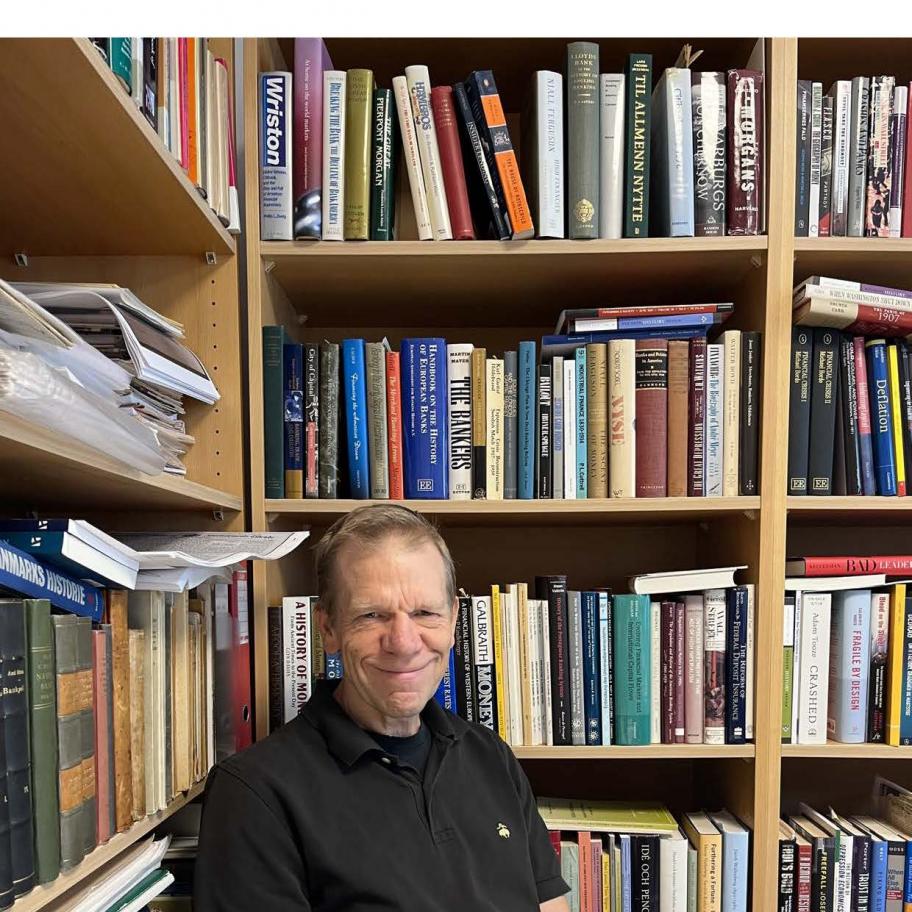







Other staff at the Centre for Business History
Martin Brandt Djupdræt, PhD fellow
Lars Heide, Associate professor emeritus
Kurt Jacobsen, Professor emeritus
Visiting Fellows
The Centre for Business History is a place of academic exchange. We welcome short- and long-term visitors who contribute to our community of scholars and bring new perspectives on history, business, and society.

Charlotte Nilssen
Charlotte is a postdoctoral researcher at the Department of Economic History at Lund University. She visited the Centre for Business History in April and May 2022 and presented her most recent project: "A Nation of Everyman Investors: Stock Saving and the Circulation of Financial Knowledge in Sweden 1978-2018".
Christian Stutz
Christian Stutz is an Jyväskylä School of Business and Economics Postdoctoral Researcher at Jyväskylä University as well as the co-leader of the project “International tensions, local nationalism, and global business: A historical perspective,” funded by the Emil Aaltonen Foundation (2022-2024). In 2022, he is a Visiting Research Fellow at our Center of Business History.
Ludovic Cailluet
Ludovic Cailluet is Professor of Strategy and Business History at Edhec Business School, France. His research foregrounds the formation and dissemination of strategy practices. He is one of the leading historians at business schools. His most recent work is on the strategic uses of the past by organizations, especially in family firms.
Stephanie Decker
Stephanie Decker is Professor of History and Strategy at the University of Bristol Management School, and head of the academic group for Strategy, International Management & Business, and Entrepreneurship. Her research is pioneering in theorizing from historical research and in developing archival and historical methods for organization studies.
Johanna Markkula
Johanna Markkula works at the Department of Sociology and Social Anthropology at Central European University in Vienna. Her research is an anthropological study of global mobile labor in the context of the maritime industry, and of the sea as a social, political and legal space that is at the very foundation of global capitalism.
Benjamin Richards
Benjamin Richards is currently a Lecturer in the management school at the University of Stirling in Scotland. He holds a Master in Cultural Heritage Management and Social Research from the University of York and was a visiting PhD Fellow at the Centre in 2021 when he presented his project about "Postfasciest Styles of Organizations."
Michael Rowlinson
Mick Rowlinson is a Professor of Management and Organisational History at the University of Exeter Business School. He is a former editor of Management and Organizational History and a senior editor of Organisation Studies. He recently co-edited a Special Topic Forum of the Academy of Management Review on History and Organization Studies: Toward a Creative Synthesis.
Stephen Cummings
Stephen Cummings is Professor of Management at Victoria University of Wellington, New Zealand. He is Otto Monsted visiting professor at our Centre for the fall semester 2022. His recent article Unfreezing change as three steps (with Todd Bridgman and Kenneth Brown), has become one of Human Relations three most downloaded articles of the past 70 years.
Kenneth James Lipartito
Ken Lipartito is Professor of History at Florida State University. His areas of specialization are economic and business history and the history of technology. He brings a multifaceted approach to his publications as well as to the classroom, where he regularly covers business history, the history of the global economy, political economy, and the history of technology.
Stephen Mihm
Stephen Mihm is a Professor of History at the University of Georgia. He is the author of "A Nation of Counterfeiters: Capitalists, Con Men, and the Making of the United States" (Harvard University Press, 2007). Stephen is an expert on the history of capitalism. He is also a weekly columnist for Bloomberg Opinion as well as a frequent contributor to the New York Times.
Roy Suddaby
Roy Suddaby is the Winspear Chair of Management at the Peter B. Gustavson School of Business, University of Victoria, Canada. He is a world-renowned scholar on the critical role of symbolic resources – legitimacy, authenticity, identity and history – in improving an organization’s competitive position. His work has been awarded best-paper prizes from the Academy of Management Journal and Administrative Science Quarterly
Research (Panel content)
Research at the Centre for Business History
The Centre for Business History conducts methodologically and theoretically based research into the historical development of the modern enterprise and its business environment.
Our research examines business within its economic, political, social, conceptual, cultural, and institutional context. We explore how enterprises act as drivers of economic development and
how their interaction with society shapes both business and broader historical change.
Through this approach, the Centre contributes to understanding the links between business and society over time. Research results are published in academic journals, featured in the media, and integrated into our educational initiatives.

Research activities and collaborations
Journal
Enterprise & Society
General editor: Andrew Popp
Enterprise & Society (E&S) offers a forum for research on the historical relations between businesses and their larger political, cultural, institutional, social, and economic contexts. The journal aims to be truly international in scope. Studies focused on individual firms and industries and grounded in a broad historical framework are welcome, as are innovative applications of economic or management theories to business and its context. E&S is published by Cambridge University Press.
Visit website: Enterprise & Society
Management and Organizational History
General editors: Anders Ravn Sørensen and R. Daniel Wadhwani
Management & Organizational History (MOH) is a peer-reviewed journal that aims to publish high quality, original academic research concerning historical approaches to the study of management, organizations and organizing. It addresses issues from all areas of management, organization studies, and related fields. The unifying theme of MOH is its historical orientation. The Journal is both empirical and
theoretical. It seeks to advance innovative historical methods and facilitates interdisciplinary dialogue. The ethos of MOH is reflective, ethical, imaginative, critical, inter-disciplinary, international, as well as historical in orientation.
MOH is published by Taylor & Francis.
Working Paper Series
Louise Karlskov Skyggebjerg, 2023
The impact, times, and resilience of objects, Working Paper.
A. Reckendrees, B. Gehlen & C. Marx, 2022
International Business, Multinational Enterprises and Nationality of the Company: A Constructive Review of Literature, Business History,
Published online 14 Sept. 2022.
R. Daniel Wadhwani and Christoph Viebig, 2021
Social Imaginaries of Entrepreneurship Education: The United States and Germany, 1800–2020.
Academy of Management Learning and Education, 20, 342–360.
Christina Lubinski and William B. Gartner, 2020
History as Source and Method for Family Business Research,
In A Research Agenda for Family Business: A Way Ahead for the Field. A. Calabrò, ed., Cheltenham, UK: Edward Elgar: 29–59
International Research Partners
We are proud to be engaging with academics from around the world and from various disciplinary backgrounds. Some of the universities with which we have collaborated in recent years include
Jyväskylä University School of Business and Economics
KTH Royal Institute of Technology
University of Bristol Management
Teaching (Panel content)
Teaching at the Centre for Business History
Teaching activities and initiatives
Developing a Bachelor Project – An Online Tutorial in 32 Videos
The Centre for Business History has developed an online tutorial to support students in writing their Bachelor projects. The tutorial was created by Alfred Reckendrees, Ana Maria Munar, Bersant Hobdari, Christoph Viebig, and Lara Monticelli.
It provides a comprehensive overview of all elements involved in writing a Bachelor thesis. The 32 short sections serve as tools for answering common questions and can be used flexibly throughout the individual work process.
Historical Entrepreneurship Case Series
Andrew Popp, Chris Viebig, Dan Wadhwani and Christina Lubinski collaborated on the Historical Entrepreneurship Case Series at Harvard Business School Publishing.
The series addresses Historical Entrepreneurship as a way to introduce greater sensitivity to context, time and change into entrepreneurship education. It outlines a teaching module with eight new cases plus teaching notes.
Each case examines an entrepreneurial opportunity historically, allowing students to consider the context for its creation, the entrepreneurial actions involved in its pursuit, and the broader changes it created in markets and societies.
Social Imaginaries of Entrepreneurship Educatio
While conventional historical narratives of entrepreneurship education focus on its rise in business schools since the 1970s, Dan Wadhwani and Chris Viebig trace its roots to the early nineteenth century and chronicle its evolution within the field of higher education more broadly.
Using a comparative-history design, they show how changing social imaginaries of entrepreneurship education in Germany and the United States were based on divergent and evolving justifications of entrepreneurial autonomy and its relationship to the common good.
Their narrative explores how these social imaginaries shaped the moral and political legitimacy of entrepreneurship and the aims, practices, and organisational forms of entrepreneurship education. They draw out the implications of this deeper history for entrepreneurship education today, including: (a) its current social imaginary, (b) the character of entrepreneurial knowledge, and (c) its relationship to the modern university.
See this video for more information on Social Imaginaries of Entrepreneurship Education.
Blended Learning
Not just since the Covid-19 pandemic has blended learning had a major impact on how we teach at business schools.
Philosophy of Science
Philosophy of Science is a core building block in the education of well-rounded business professionals and scholars.
Kurt Jacobsen, Thomas Presskorn-Thygesen and Anders Ravn Sorensen collaborated on developing novel and engaging Philosophy of Science teaching at CBS. Their work helps students question their perspective and outlook on the world – a crucial skill for business in fast-changing societies.
Rethinking Business School Education
The history of management isn’t what it used to be. It used to be settled, neatly contained within a box. That box was often called “Chapter 2” in management textbooks, and it conveyed the idea that
the business school taught management as a collection of subjects built upon economics and other sciences like psychology and mathematics.
This history was part of any management student’s induction. It provided a solid foundation, but a limited palette. That monochrome palette was crisp, clear, and concise – and also pale, male, and increasingly stale.
How do we rethink histories of the Business School? And how does that help us rethink the future of teaching business?
Transformational Capabilities
It is core to Copenhagen Business School’s strategy to prepare students for grand societal challenges and an ever-changing business environment.
CapLab (short for Capabilities Lab) is a strategic initiative centrally funded by CBS and carried out by an interdisciplinary group of researchers who purposefully integrate transformational capabilities into CBS ’educational portfolio.
To learn more about their activities, see caplab.cbs.dk or connect with the principal investigators Chris Viebig and Christina Lubinski.
Seminars (Panel content)
Research Seminar Series
The Centre for Business History organises a regular research seminar series where we discuss work-in-progress and engage in methodological discussions in our Spotlight seminars.
For new ideas on work in history and temporality research, we have a regular History Slam, which also provides an opportunity for new collaborations within and beyond our discipline.
Our first priority for the seminar series is emerging scholars, whom we support in developing papers and book projects.
Our PhD students, moreover, have several Work-in-Progress seminars with internal and external commentators. We also occasionally invite external guests if their topics are a close fit with our interests.
Seminars are scheduled ahead of each semester. Feel free to reach out if you would like to explore a visit.
“The knowledge and diversity of the participants ’understandings of history allow for a constructive space for developing both the presenters ’papers and the common cause – the significant contribution of history to business research and teaching.” Christian Stutz
Jyväskylä University School of Business and Economic

About the seminar series
The seminar series provides a forum for academic exchange, methodological reflection, and collaboration across disciplines.
Methodological focus
We regularly devote sessions of the seminar series to methodological questions and have had good discussions of Microhistory and Hermeneutics (Dan Wadhwani), Materiality and Embodiment (Louise Karlskov Skyggebjerg and Martin Djupdræt), Social History / Longue Durée (Alfred Reckendrees) and Uses of the Past (Mads Mordhorst) in recent semesters.
Our History Slam for discussing paper ideas is popular with both internals and visitors.
Seminar experiences
Every fall semester, we join all research groups of our department for an interdisciplinary retreat in Helsingør to discuss our work with management and entrepreneurship scholars, philosophers, political scientists, and legal scholars.
“I received in-depth reflections on my work, new perspectives through which observing my empirical materials, and more detailed advice on publishing by experienced editors and authors. It was a truly developmental and inspirational experience!” Camilla Ferri
Ca ’Foscari University of Venice