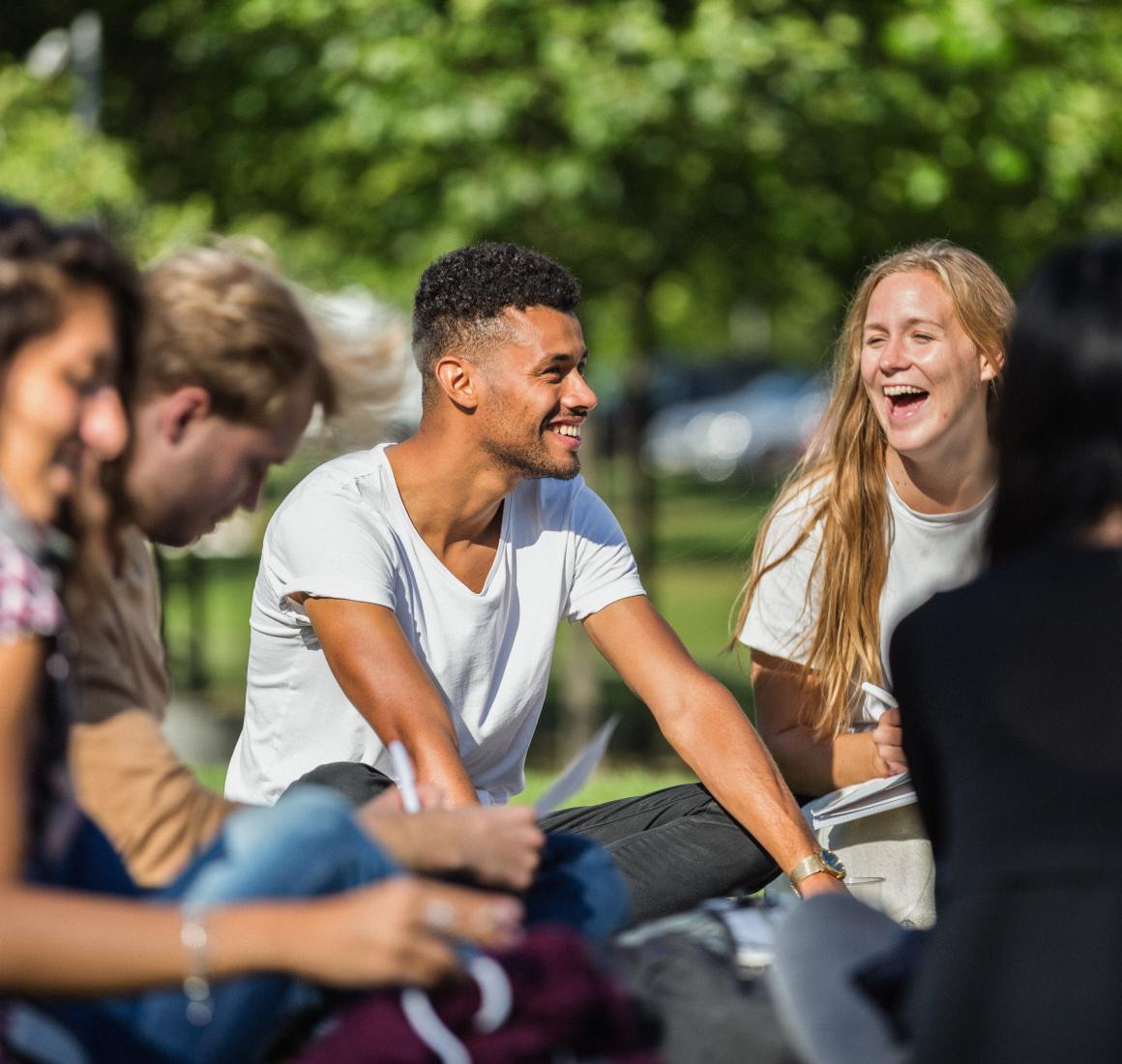
Teaching and working methods
At CBS you will have both lectures and exercise classes. You should also expect to spend time on preparing for classes and exams both individually and in groups with your fellow students.
Research-based education
When you study at university, you become part of a research environment. Already in your first semester, you will be taught by researchers who actively contribute to creating new knowledge within their field. They provide you with insights into the latest research while also training you to be curious and think critically. This helps you gain new perspectives on what you learn and the work you engage in.
Bridge between theory and practice
In addition to being taught by researchers, you will also meet external lecturers who work in the private sector or in public organisations. You will therefore encounter real-life cases that provide you with insights beyond a theoretical level. They might, for instance, explain how they apply theories and models in their everyday work. This makes it easier for you to understand how your curriculum is relevant and can be used in practice. At CBS, you are therefore introduced to theory as well as practice-oriented teaching.
You are trained to find solutions
In class, you will be asked to discuss theories with both your lecturer and fellow students. Here, you are encouraged to be critical and inquisitive. You do this by asking curious questions or exploring new perspectives on the topics you discuss. When you work on an assignment or project, you also learn to take a scientific approach by reflecting on which theory and analysis to apply to solve a given problem.
In this way, your lecturers help train you to ask questions such as: “Why should I use this method?” or “What are the advantages and disadvantages of using other methods?” This mindset is what you will need once you graduate and enter the business community, where you will contribute to finding solutions to some of the challenges we face as a society.
Teaching formats at CBS
You will experience different types of teaching at CBS. The most common are:
- Lectures: usually, a lecturer will review the readings from the syllabus and put them into perspective in an auditorium. Most students take a lot of notes during the lectures.
- Exercise classes: are often scheduled in continuation of lectures with smaller groups of approximately 30-40 students with a lot of dialogue between the lecturer and the students. You often do some exercises based on what has been reviewed during the lecture.
The vast majority of your lectures and classes take place on campus, but you may have a few courses or activities that take place online. It is therefore expected that you show up on campus and participate in classes.
Time consumption
All CBS bachelor and master programmes are full-time programmes. This means you should expect to spend approximately 37 hours on average on your studies each week. You will spend your time on:
- participating in and preparing for your lectures and exercise classes
- doing individual and group work
- preparing for and taking your exams
The workload and the number of hours you spend studying will vary during the semester and throughout the year. The time leading up to assignment submissions and exams can be hectic, and you can easily work more than 40 hours a week in this period.
Timetable
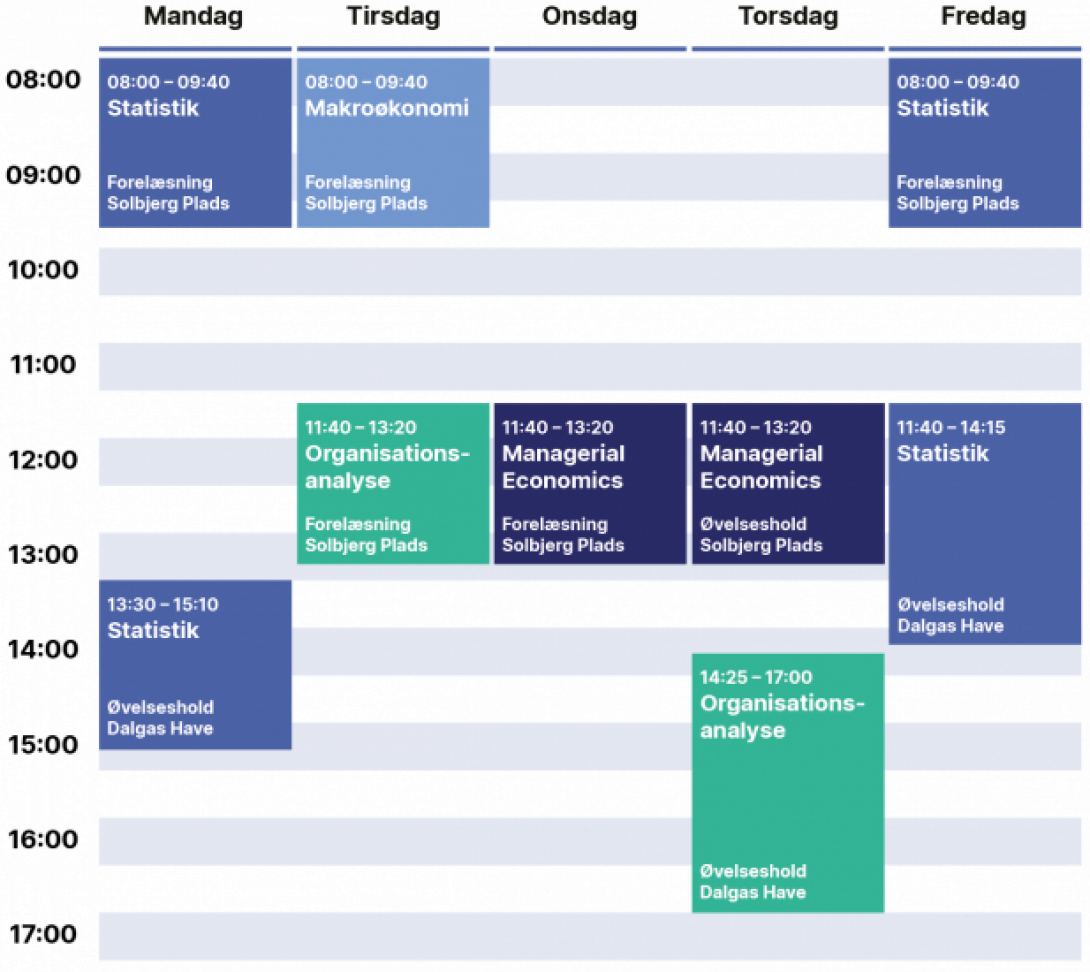
You should expect to have 12-14 hours of teaching on average per week scheduled in the daytime from Monday to Friday. You will have time before, in between and after classes for different things.
Most students spend their time on individual preparation, voluntary and compulsory group work or writing assignments. But you could also spend the time relaxing with friends, drinking a cup of coffee in the student cafe Nexus or working at your student job.
Participate actively in teaching activities
To get the most out of your classes and contribute to a positive learning environment with your fellow students, you are expected to attend classes regularly. At CBS, it is your responsibility to come prepared and actively participate in class. This includes asking questions and engaging in academic discussions with your classmates and instructors.
It can be tempting to use AI as a study partner at home to make everyday life more efficient. However, at CBS we aim to create a dynamic learning environment that gives you the best opportunities to learn during classes and build connections with other students. The relationships you develop can be valuable when preparing for exams and may become part of the professional network you draw on later in your career after CBS.
Compulsory activities
At CBS, your lecturers do not check whether you show up for class or how high your absence is. However, it is important that you prioritise coming to your classes. You risk missing out on important information and discussions if you do not show up, and you cannot expect everything to be available online.
In some courses you have to pass different compulsory activities in order to participate in the exam. This could be a multiple choice test, a submission of an assignment or an oral presentation.
Preparation
In addition to attending classes, you should expect to spend 20-25 hours per week preparing for classes.

Preparation time for classes and exams
You may have to read a few chapters or an academic article as preparation before a lecture. You might also spend time on either taking notes or underlining the most important points while reading.
Before an exercise class, you will also often have to prepare a case or do various calculation tasks in advance, which will be reviewed during the exercise class.
As a student at CBS, you have the opportunity to sit at the library in quiet surroundings and read and prepare for your classes and exams. You can also book a group study room if you and your study group are preparing a case for an exercise class or writing an exam paper together.
Group work
In most study programmes assignments and preparation for teaching activities and exams will be done in groups. Many students also choose to form study groups, where they meet and discuss the syllabus, go through assignments and prepare for teaching activities or exams together.
Working in groups has many advantages. You learn a lot from talking with your fellow students about your syllabus and get other perspectives on what you read. You can also help each other out if there are difficult things in the syllabus, and you can share an interest for the courses you find most exciting.
You also learn a lot about yourself and how you and other people react in a collaborative setting. It will give you a lot of good tools, you can use, when you later start a job where you have to collaborate with people who may not be similar to you.
The other students in your group can also become the ones you do social things with outside of class. They are often the ones who help you keep your motivation up and get you through the busy periods.
Teaching and literature in English
CBS offers bachelor and master programmes taught in either Danish or English. Sometimes you will also find courses taught in English in Danish-taught programmes.
You should expect most of your literature to be in English, even if your programme is taught in Danish. It requires some extra work from you to get used to reading literature in English at first, but you will quickly get used to reading in English and expand your vocabulary.
Practice makes perfect
There is a big difference between reading and understanding texts and expressing yourself in English both orally and in writing. This is a challenge for some students. Even if you are used to reading English texts on your bachelor programme, it is still a good idea to practice your English. Try to speak it on a regular basis, watch the news, movies and TV series in English. You should also read books and newspapers in English, as this will help you read faster and increase your vocabulary. A good command of English is essential for getting the maximum learning outcome of your programme.
Considering applying for a programme taught in English?
Before applying for a programme taught in English you might want to consider the following:
- All literature, lectures, exams, projects and group work are in English.
- Academic English differs from the English used in everyday life – so it might be a challenge even if you are used to speaking English in other situations.
- You may have to spend more time on reading and understanding the material in English.
- You may find it challenging to express yourself with the same ease as you would in your mother tongue.
- Some will feel uncomfortable and shy when speaking English – especially when in a crowd or among native speakers.
Hear a student guidance counsellor explain what it is like to study a programme taught in English.
Bachelor (Panel content)
Master (Panel content)
Teaching and exam periods
Teaching and exam periods - autumn semester
The autumn semester runs from 1 September to 31 January, but you will not necessarily have classes and exams throughout the entire period. This depends on your courses, your timetable and your exam dates.
Exam dates for the autumn semester are published on 1 September. The specific dates for your individual exams will be published no later than one month before the exam takes place.
| Classes | Exams | Reexams | |
|---|---|---|---|
| Semester | September - December | December - January | February |
| 1st quarter | September - mid-October | October | December - January |
| 2nd quarter | November - December | January | February - March |
Teaching and exam periods - spring semester
The spring semester runs from 1 February to 30 June, but you will not necessarily have classes and exams throughout the entire period. This depends on your courses, your timetable and your exam dates.
Exam dates for the spring semester are published on 1 February. The specific dates for your individual exams will be published no later than one month before the exam takes place.
| Classes | Exams | Reexams | |
|---|---|---|---|
| Semester | February - May | May - June | August |
| 3rd quarter | February - March | Late March – early April | Mid-May – late May |
| 4th quarter | Mid-April – May | Late May – late June | August |
Public holidays
CBS follows the official public holidays in Denmark, during which there are no classes or exams.
- Christmas and New Year: There are no classes or exams between Christmas and New Year. However, you may have exams in early January that you need to prepare for.
- Summer break: There are no classes in July and August. However, reexams for the spring semester take place in August.
Do you have an autumn or winter break?
There is no break during the autumn holiday (week 42) or the winter holiday (weeks 7/8). There may be both classes and exams during these weeks, depending on your courses and lecturers.
| Holiday schedule: 2026/2027 | |
|---|---|
| 24 - 26 December | Christmas |
| 1 January | New Year’s Day |
| 29-25 March | Easter |
| 6 May | Ascension Day |
| 16-17 May | Whit Sunday and Whit Monday |
| 5 June | Constitution Day |
| July - August | Summer break - retake in August |
Read more about student life
Learn more about what it is like to be a student at CBS. You can e.g. read about programme structure, teaching activities, exam formats, or the social life on campus.
Student life at CBS

Exams
In need of special support?