MSc in Economics and Business Administration in People and Business Development
Last intake was in 2025.
The programme gives you the keys to understand why and how the organisation’s people and human capital become the key drivers of business development and transformation in modern organisations.

Om MSc in Economics and Business Administration in People and Business Development
Last intake was in 2025
It is no longer possible to apply for this programme.
Why study MSc EBA PBD?
To like and do well in the programme MSc EBA PBD you should be interested in
You are into Strategic HRM
Organisational Change and Transformation
Data-Driven People Analytics
“The best thing about the programme is the focus of using larger projects and cases to develop competencies in understanding organisational people processes.” Emilie
Student, MSc EBA PBD

Human resources as change driver
MSc EBA PBD is a business-oriented degree focused on developing and applying people strategies and business development tools to create value and drive change in modern organisations. The programme emphasies the alignment of human resources with business goals. This is especially needed in a time of increasing digitalisation, and other transitions that organisations need to adapt to.
Data- and theory based analysis
MSc EBA PBD aims to develop candidates who are equipped to do data- and theory based analysis of the highest level and aiming at three specific areas of interest.
Three values
The programme is based on the idea that modern people strategies and human capital must focus on context, value, and change. This focus helps management and staff working with human capital reach their full potential. It enables them to act as both business partners and change agents.
“PBD has sparked my interest in how to develop organisational capabilities through the people that constitute the organisation, and this I wish to work with. ” Emilie
Student, MSc EBA PBD
Context
As a PBD candidate you will know more than the received wisdom of the discipline HRM-best practice. You will be able to analyse people’s strategies in context in order to assess what human capital and people policies, actions and techniques which are likely to create most value in a specific organisation.
Value
Also, you will be able to analyse the organisation “black-box”. So, with the help of economic and data-based analyses you can identify what aspects of human capital and HRM need to be developed, adjusted, or discarded in order to make the organisation perform most efficiently and create the most value.
Change
Finally, as a candidate from MSc EBA PBD you will be both a manager of organisational systems, and a change agent. You will be able to analyse the needs and prerequites for leading the processes of strategic business transformation.
Info meetings about admission
Participate in the admission information meeting where we guide you through the application process and explain quota 1 and 2, language requirements and admission requirements.

Opbygning
Organisation og ledelse
You learn how leadership, collaboration, and organisational design shape performance and development. Organisation and management in MSc EBA PBD focus on how to lead and motivate people, drive change, and create environments where employees and organisations thrive.
HR
You learn how HR strategies and practices support business goals through people development and engagement. The focus is on designing initiatives that strengthen talent, learning, and collaboration, ensuring that people are at the centre of organisational growth.
3 things to consider
Strong analytic elements
Do you have a strategic mindset ?
Driver of organisational change?
Options
Electives
On the 3rd semester, you can choose to study courses of your specific interest. CBS offers a large number of electives within a wide range of topics. You can also choose to take electives at other Danish universities. The electives you choose have to be relevant for your programme.
See the current selection of CBS electives on Courses at master level.
Minor
On the 3rd semester, you can also choose to study a so-called minor. A minor is a package of electives within a specific academic area. Typically, it consists of 3 courses. By taking a minor, you strengthen your competences within a specific area of interest, and you can use it to qualify for specific jobs or industries.
See the current selection of CBS minors on Minors.
Exchange
Many students choose to go on exchange on their 3rd semester; usually at one of CBS’ more than 300 partner universities. When you go on exchange through CBS, you do not have to pay for the teaching at the foreign university (with a few exceptions), and you can bring your SU (student grant).
Find a list of all CBS partner universities here.
Academic internship
You can choose to replace some of your electives with a so-called academic internship. The academic internship consists of an internship period at a company, which is then completed with a project report. You can do the internship at a company in Denmark or abroad.
When doing an internship you get the opportunity to relate theory to practice and reflect on the academic training you receive at CBS in a practical setting. Therefore, the project report and work assignments during your internship have to be relevant to your study programme.
CEMS
On People and Business Development, you can apply for the CEMS - Master in International Management programme. CEMS MIM is a double degree programme, which gives you the opportunity to add a second degree in international management to your CBS degree. This means that you will get both the MSc degree and the CEMS in International Management degree.
CEMS is a 1-year programme, which you study in combination with your CBS degree in your 3rd and 4th semester. Part of it takes place at one of the other CEMS universities abroad.
Learn more about CEMS / Master in International Management.
Master's thesis
Your 2nd year is completed with a master's thesis. You choose the topic you want to write about, which allows you to focus on a specific topic of your interest. Typically, you write your master's thesis with a fellow student.
“The best thing about the programme is the focus of using larger projects and cases to develop competencies in understanding organisational people processes” Emilie, MSc EBA PBD
Studiemiljø
Study Environment
The PBD-student programme is previously drawn from diverse origins; 20% international and 80% Danish students, but with a growing number of international students.
A majority comes from CBS bachelor programmes of which a fair amount comes from the bachelor programmes: HA(psyk.) and BSc SEM. The gender distribution is around 75% women /25% men. Uncharacteristically for the field, 80% of the teachers are men.
Student life at CBS
Studying at CBS is much more than just preparing for and going to classes.
At CBS, there are more than 20,000 students with different backgrounds and nationalities. Teamwork is an essential part of studying at CBS both in classes and in extracurricular activities.
With more than 100 student organisations, you also have plenty of opportunities to engage and connect with students across programmes and classes.
Learn more about the vibrant student life at CBS, the student organisations, and the international environment on Student life.
Studying in English
If you do not have a bachelor degree taught in English, we recommend that you read more about what to consider before applying for an English taught programme.
Read more about Teaching and literature in English on Teaching and working methods.
Mød de studerende

For internationals
Are you interested in studying at CBS as a full degree or exchange student? Or participating in CBS Summer University? Are you a freemover or do you want to study a single course? Here you can find information regarding how to apply, how to prepare for life in Denmark and what studying at CBS is like. Welcome!

Teaching and Exams
While the PBD-programme competences are based on evidence- and theory-based analyses, these skills are built using a diverse range of cases of which many are “live-cases”. The PBD projects are the most extensive of these: you and your group will work in 2,5 months on a real-life people and development change project supported by a supervisor.
But all teaching at the PBD-programme is extensively anchored and contextualised by organisational cases. The course is organised in four 15 ECTS blocks, which lets you immerse yourself in the same topic and exercise your skills to a deeper level of understanding.
Read more about Teaching and working methods.
Read more about exams on Exams at CBS.
Student life at CBS
Being a CBS student is about more than going to lectures and doing exams.
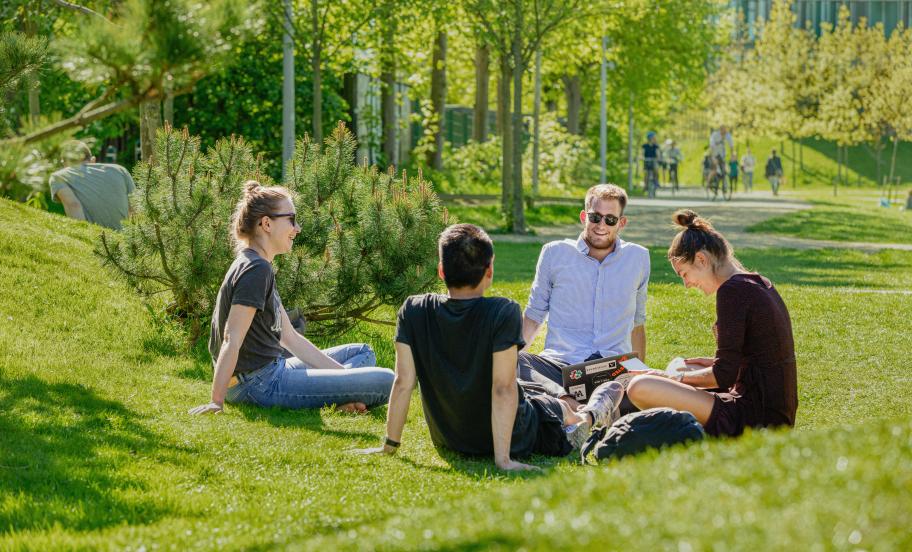
Get a glimpse of student life at CBS. Here, you can explore what a typical day of teaching and exams looks like.
Also, you can learn how our programmes are structured and read about social life on campus, including the many ways to connect with fellow students.
Time consumption
Workload
You should know that it is demanding to study in a graduate programme, and both the curriculum and workload is significantly higher than at bachelor level.
If you are studying on a full-time graduate programme, you should expect spending approximately 37 hours on average on your studies each week. The workload will vary during the year.
Hectic around exams
The time leading up to assignment submissions and exams can be hectic, and you can easily work more than 40 hours a week in this period. Preparing for oral exams can be especially time consuming, because you have to be able to explain and discuss the covered concepts and theories and learn things by heart.
Read more on Teaching and working methods
Student job
Most programmes are quite flexible in terms of combining studies with a student job. Most students work a maximum of 15 hours a week in order to have sufficient time for their studies.
Studying in Denmark - for internationals
If this is your first time studying in Denmark, you may find teaching and exam formats, the grading scale and the academic calendar very different from what you are used to.
Read about everything you need to know as an international student studying at CBS on International students
In need of special support?
Do you have a disability such as dyslexia, anxiety, autism, ADHD, long-term effects of concussion or another physical, psychological or neurological disability?
Then you have the opportunity to apply for Special Educational Support (SPS) and special conditions while studying.
This ensures you can study on equal terms with your fellow students.

Adgangskrav
Last intake was in 2025
It is no longer possible to apply for this programme.
Info meetings about admission
Participate in the admission information meeting where we guide you through the application process and explain quota 1 and 2, language requirements and admission requirements.
Karriere
People and business
This programme prepares you for careers in HR, management consulting, business development, or strategic change management. Particularly in roles at the intersection of people and business.
Analytics help transform business
The programme builds the HRM business analytic capabilities you will need to take a central leadership role in business development and transformation processes. In the still more complex world of work and business, the record shows that organisations need still more candidates who can fill leadership positions within people management.
In order to succeed in this role, you must understand the importance of the contexts for people strategy, performance and value management and strategic business transformation, as, for instance, disruption caused by digitalisation.
Competency profile
In the competence profile you can find more information about the various competences you achieve on the programme:
What do you learn on MSc EBA PBD?
Tailor HR strategies to real-life situations
Confident working with data and business thinking
Lead change and make things happen
Career opportunities
Graduates work in various industries such as:
- Management Consulting
- Human Resources and Talent Development
- Financial Services
- Pharmaceuticals and Healthcare
- Public Sector and NGOs
Graduates work with the job tasks like:
- Talent Management & HR Strategy
- Organisational Development & Change
- Strategy and Business Consulting
- Project and Change Management
- People Analytics & Reporting
Life long learning
We want you, as a student, to continue developing both personally and professionally throughout your life. CBS aims to support you in applying your knowledge in your organisation and company. Our goal is for you to keep expanding your knowledge and skills, to engage actively in organisational and societal development, and to contribute to shaping a sustainable and democratic society.

Mere om MSc in Economics and Business Administration in People and Business Development
Last intake was in 2025.
The programme gives you the keys to understand why and how the organisation’s people and human capital become the key drivers of business development and transformation in modern organisations.




Andre kandidatuddannelser
Er du nysgerrig på lignende uddannelser? Måske finder du her en anden uddannelse, der også passer til dine interesser og karrieredrømme.