Department of Digitalization
The Department of Digitalization (DIGI) is the largest European university department dedicated to the social science study of information technology. We focus on how trends and innovations in social science and humanities shape technical capabilities of emerging technologies, and how those technologies can be used in business and society.

About the department (Panel content)
Who we are
We bring together researchers from a wide range of fields to address the most important challenges for individuals, organizations, and society.
60+ experts from multiple disciplines
7 focused research themes
25+ research projects globally
NEWS FROM DIGI


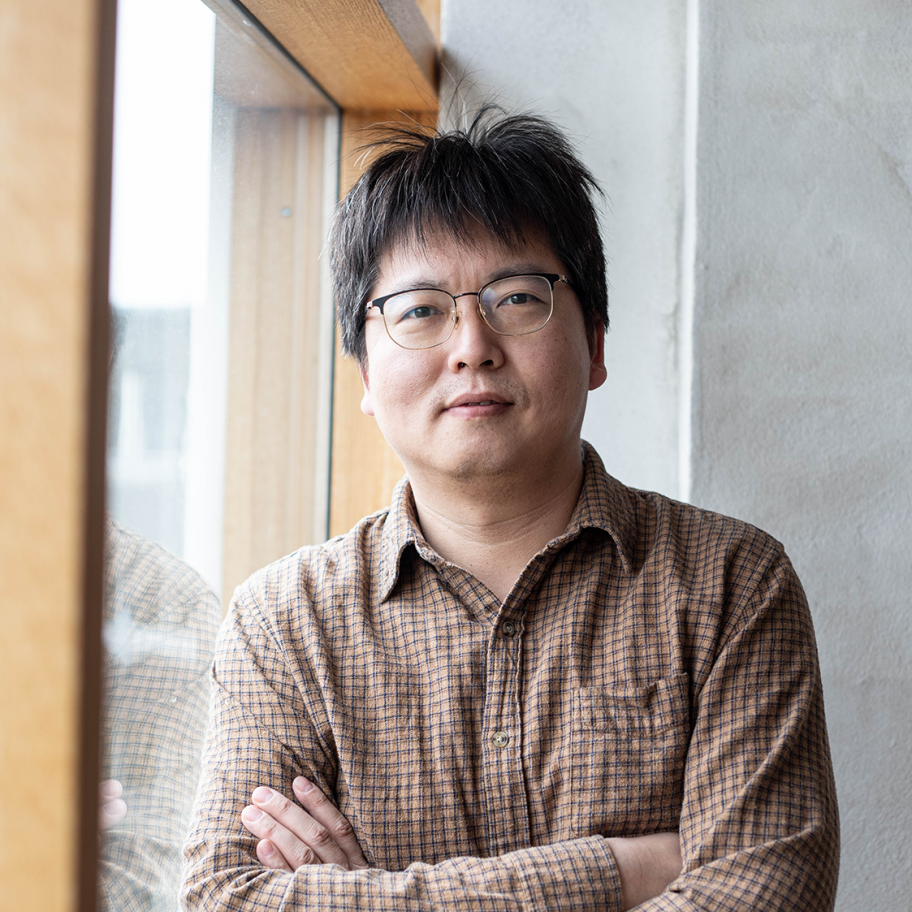
“At DIGI, we don’t just study technology. We help shape its meaning and impact in the world. Our ambition is to be a visible, critical, and constructive voice in the digital age.” Andrea Carugati
Head of Department

Research with societal impact
Research themes
Our research examines how digital technologies influence organisations, decision-making, innovation, governance, and everyday life.
Areas of expertise include artificial intelligence, data-driven organisations, digital platforms and ecosystems, cybersecurity, digital sustainability, public-sector digitalisation, and the societal implications of emerging technologies.
Read more
Research with impact
DIGI researchers address questions that matter beyond academia.
Our work contributes knowledge that helps organisations, policymakers, and society navigate the opportunities and challenges of digital transformation, while informing debates on responsibility, transparency, inclusion, and sustainability.
Collaboration and engagement
Collaboration is central to our research approach.
We work closely with companies, public institutions, policymakers, and international research communities to ensure that our research remains connected to contemporary challenges and contributes to informed decision-making in practice.
Education and academic community
Research and education are closely connected at DIGI.
We contribute to a range of degree programmes at Copenhagen Business School and are committed to providing research-based teaching that prepares students to understand and shape digital transformation. At the same time, we foster a vibrant academic community that supports collaboration, knowledge exchange, and the development of future researchers.
Information for external lecturers can be found through this link.
Life at DIGI
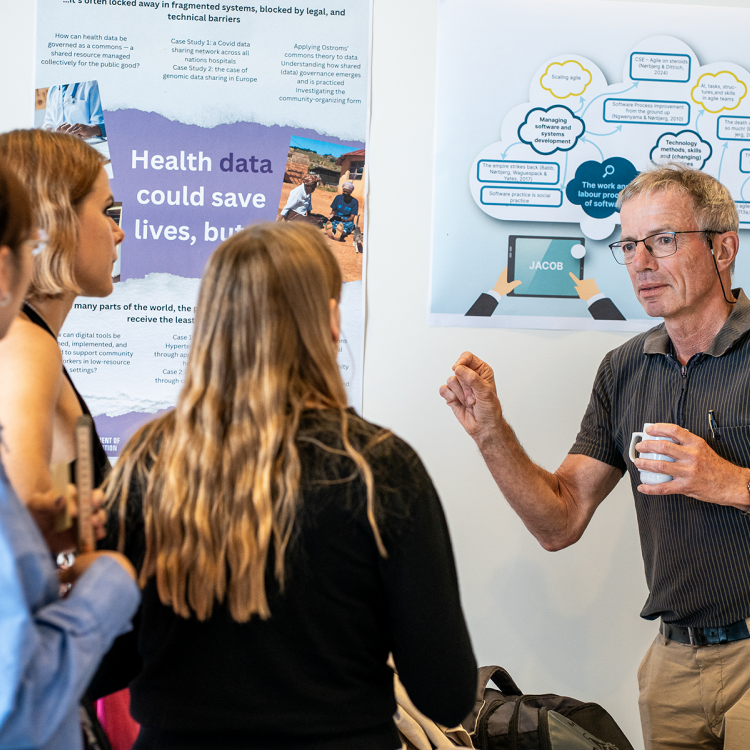
Collaboration across competencies
At DIGI, researchers and administrative staff work closely together to ensure effective coordination of teaching, projects, and external activities. This means that companies encounter a professional environment where structure and flexibility coexist—important when projects evolve or new opportunities emerge.

Connecting research and teaching
Teaching is developed in close connection with ongoing research. Faculty members integrate new findings and cases from current projects into their courses, ensuring truly research-based teaching. The administrative team supports this work and helps maintain a coherent and efficient learning environment.
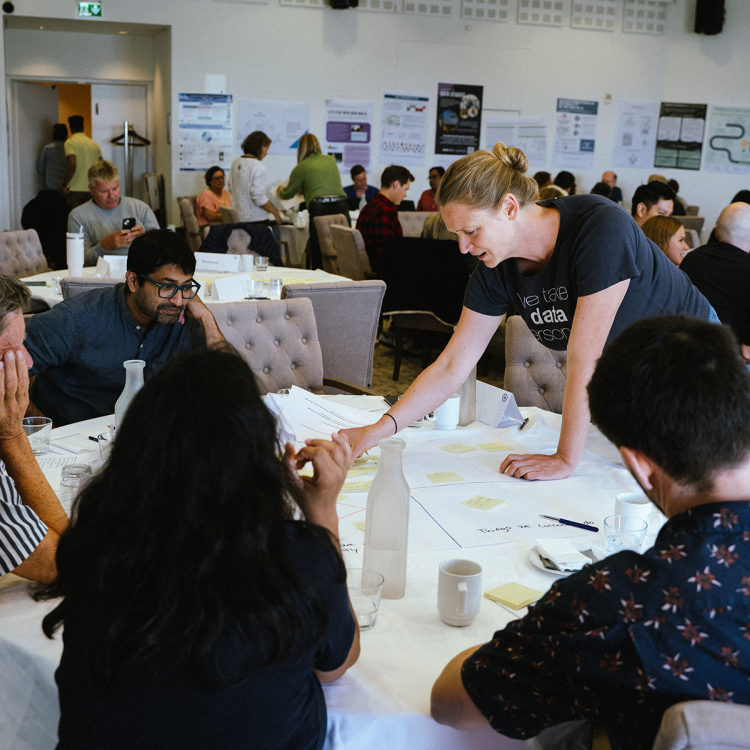
A vibrant knowledge environment
Daily life at DIGI features seminars, guest lectures, and workshops that continuously introduce new perspectives. Other periods focus on analysis, writing, and conceptual development. What remains constant is a culture driven by curiosity, dialogue, and the ambition to produce knowledge that matters—academically and in partnership with industry.
A diverse community shaping the digital age
Meet us here
Academic community
DIGI hosts a range of academic activities throughout the year, including research seminars, workshops, conferences, and visits from international scholars. Together with collaborations across industry and the public sector, these activities strengthen our research community and connect academic insights with real-world challenges.

Digital Sustainability

Digital Government

NeuroLab

Centre for Business Data Analytics (cbsBDA)
Research and publications (Panel content)
Research that shapes the digital age
At the Department of Digitalization (DIGI), our research is organised around dynamic, medium-term themes—typically active for 3–7 years—that reflect emerging areas in which digital technologies reshape individual, organisational, and societal life. This flexible structure enables interdisciplinary collaboration and ensures that our research remains closely aligned with the evolving digital landscape. We take pride in contributing to the field’s leading journals; through the efforts of our faculty, CBS ranks #1 in Europe and #4 globally in publications within the “Basket of Eight” (Bo8) Information Systems journals.
Our current research is anchored in seven focused themes: Blockchain in Business & Society, Data Studies, Digital Ecosystems, Digital Government, Digital Sustainability, Digital Transformation of Work & Society, and Hybrid Threats & Defence Tech. Together, these themes reflect the breadth and depth of DIGI’s engagement with the digital transformation of business, public institutions, and society at large.
Our research themes
Blockchain in Business & Society
Blockchain is emerging as a foundational digital infrastructure with the capacity to reshape transactional processes and organisational arrangements. This research theme examines the technological characteristics and governance mechanisms of blockchain and smart contracts, and explores how these can support new socio-economic systems and business models across a range of markets.
Data Studies
Data Studies examines how data is produced, organised, and governed across organisations and society. The theme investigates the social, technical, and ethical dynamics of data-intensive practices, including how platforms, algorithms, and infrastructures mediate data flows and shape organisational decision-making. Our researchers explore how norms, regulations, and routines influence data collection and use, and how these processes affect transparency, accountability, and societal outcomes.
Digital Ecosystems
Digital Ecosystems examines how contemporary digital technologies create interconnected socio-technical environments that span organisational, cognitive, industrial, and societal boundaries. The theme uses ecological thinking to analyse digital ecosystems as a core unit of inquiry and to understand how they shape strategy, innovation, and governance. Our research draws on diverse theoretical and methodological perspectives to explore areas such as platform ecosystems, digital infrastructures, the political economy of digitalization, and emerging technologies.
Digital Government
Digital Government examines how public organisations design, implement, and govern digital technologies that reshape administrative processes, service delivery, and citizen–state interactions. The theme explores the institutional, organisational, and societal dynamics that influence digital transformation in the public sector, including questions of governance, accountability, and data use. Our research investigates how digital infrastructures, platforms, and algorithms support or challenge public value creation, and how emerging technologies affect transparency, democratic participation, and the evolving role of government in a digital society.
Hybrid Threats & Defence Tech
Hybrid Threats & Defence Tech examines how digital technologies shape contemporary security environments characterised by blended military, cyber, informational, and societal threats. The theme investigates the organisational, technological, and geopolitical dynamics that underpin hybrid risk landscapes, and how emerging defence technologies influence governance, resilience, and decision-making. Our research explores areas such as cyber operations, information manipulation, critical infrastructure protection, and the integration of advanced digital systems in defence and security practices.
Digital Sustainability
Digital Sustainability sits at the intersection of digital technologies and sustainability. We draw on a socio-technical perspective to study how digitalization shapes social, environmental, and economic well-being, considering both enabling and adverse effects. Our work focuses on systemic change toward more regenerative forms of value creation across individual, organizational, and societal levels. Key areas include circular economy, sustainable consumption, biodiversity, and the green transformation.
Digital Transformation of Work & Society
Digital Transformation of Work & Society examines how digital technologies reshape work practices, organisational processes, and employment relations. The theme investigates how platforms, algorithms, AI, and new digital infrastructures enable flexible and mobile forms of work, redefine professional roles, and transform decision-making and coordination in both private and public organisations. Our research explores emerging models of digital labour, the design of technology-enabled work practices, and the implications of data-driven management for wellbeing, autonomy, and the future of meaningful work.
Publications
See all publicationsdecember 2026
Reconceptualizing Digital Product Passports: Integrating Representation and Performativity for Sustainability Transformation
In: Electronic Markets. 36, 1019-6781, 19 p.
Journal article
Anne Ixmeier
Franziska Wagner

Christiane Lehrer, Associate Professor

Cecilie Lundqvist, PhD fellow
Johann Kranz
december 2026
Task-Technology Fit and the Productive Use of Generative Artificial Intelligence in Student Global Virtual Teams
In: The International Journal of Management Education. 24, 1472-8117, 17 p.
Journal article
Wendy Farrell
Ernesto Tavoletti
Dhruv Pratap Singh
Jennifer Leigh
Vas Taras
2. september 2026
Ai-ekspertgruppe: Regeringen behøver slet ikke starte forfra – blot tag et kig på vores anbefalinger
In: Monitormedier A/S
Net publication - Internet publication
Birgitte Vedersø
Hanne Leth Andersen
Mette Andreasen
Mikkel Aslak
Inger Bo Augustinus

Jan Damsgaard, Professor
Tine Wirenfeldt Jensen
Per Størup Lauridsen

Bent Meier Sørensen, Professor
Interested in collaborating?
Visiting Speaker Opportunities
We welcome engagement from researchers, practitioners, and organizations to share their work through our Practitioner Seminar Series, Tuesday Brownbag Seminars, and Friday Renowned Scholars Seminars. Please contact the following:
Practitioner Seminar Series
Jan Damsgaard (jd.digi@cbs.dk)
Brownbag Seminars
Jonas Hedman (jhe.digi@cbs.dk)
Renowned Scholars Seminars
Michel Avital (avital@cbs.dk)

Education (Panel content)
Our contribution to programmes and courses
Teaching profile
CBS is a teaching-heavy business university, where much of our time is dedicated to research-based teaching. Ideally, we teach what we research in, and research what we teach. At DIGI, we aim to be among the first departments to apply advanced IT and digital tools in the classroom—both for exploration and exploitation.
Programme responsibility
The Department of Digitalization is responsible for a wide portfolio of programmes and courses across CBS, from bachelor to executive level. We coordinate two bachelor programmes, three master programmes, and contribute to a broad range of bachelor and master electives, graduate diplomas, and the Master of Business Development.
Bachelor programmes
The HA(it.) programme provides you with a broad understanding of the opportunities and challenges businesses face in relation to IT. You will gain the tools to select, develop, and implement IT systems that take into account the company’s business and organisational context.

HA(it.) - erhvervsøkonomi og informationsteknologi
Master programmes
CBS offers a range of MSc programmes that explore how digital technologies and data shape business, management, and society. Whether focusing on information systems, data science, or digital innovation, these programmes equip students to bridge technical and organisational domains — combining analytical skills, strategic insight, and an understanding of how technology can drive business transformation.

MSc in Business Administration and Information Systems

MSc in Business Administration and Data Science

MSc in Business Administration and Digital Business
Being a PhD student at DIGI
The Department of Digitalization runs a successful Ph.D. program with more than 20 Ph.D. fellows currently enrolled. Department of Digitalization (DIGI) focuses on digitalization in business and society. DIGI strives to collaborate with industry and society through engaged scholarship while pursuing rigorous research that explores the fast-moving pace and radical innovation and social change that characterizes digital phenomena.
The aim of our Ph.D. program is to produce Ph.D. candidates at a high international level. In addition to learning how to conduct research at an international level, students will acquire a broad theoretical and methodical insight into both the socio-technical and computational fields depending on the chosen research project. The socio-technical research projects draw mostly on the social sciences (information systems, management, economics, psychology, sociology, etc.). The computational research projects draw on data sciences, design science, and computer science.
Current enrolled PhD students


Interested in a PhD Fellowship at DIGI?
Passionate about shaping the digital future? Join DIGI’s PhD line spanning research from socio-technical perspectives to data and design science.
Join us
Employees (Panel content)
Working at DIGI
Where will you find us?
All DIGI members are located in the same building at CBS on Howitzvej 60. This physical proximity creates opportunities for collaboration across research groups, career stages and professional functions, while also strengthening the informal interactions that are an important part of everyday academic life.
A culture of collaboration and belonging
At DIGI, we value diversity of backgrounds, perspectives and expertise. We strive to create an environment where everyone feels welcomed, respected and able to contribute.
Our community is built on openness, trust and constructive dialogue. Researchers and staff work closely together across disciplines and roles, creating connections that enrich both research and daily working life.
We value both individual autonomy and collective responsibility. This means creating space for focused work and academic independence while also investing in the shared activities and relationships that strengthen our community.
Professional development and community
DIGI is committed to supporting the professional development of its researchers, PhD fellows and professional staff throughout their careers.
We create opportunities for learning, feedback and academic exchange through seminars, workshops, research presentations and informal discussions. These activities strengthen both individual development and the collective research environment.
We also recognise that a thriving academic community is built through more than research alone. Social events, shared celebrations and everyday interactions contribute to a sense of belonging and collegiality across the department.
By bringing together people with different expertise, experiences and perspectives, DIGI aims to be a place where individuals can grow professionally while contributing to a vibrant and supportive academic community.
Fostering a positive work environment
A healthy work environment is essential to both well-being and academic excellence. DIGI is committed to maintaining a workplace characterised by respect, professionalism and psychological safety.
We encourage open dialogue, curiosity and constructive disagreement, recognising that new knowledge often emerges through discussion and critical reflection. At the same time, we are committed to ensuring that all members of the department feel comfortable raising questions, sharing ideas and participating in conversations across differences in seniority, discipline and experience.
Through both formal initiatives and everyday interactions, we seek to cultivate a workplace where people can thrive, collaborate and contribute to research with societal impact.